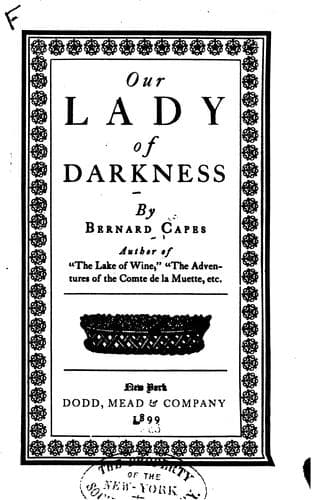
British -- France -- Fiction; France -- History -- Revolution, 1789-1799 -- Fiction; Historical fiction
“Fool!” whispered Belial, still reasoning with him. “Does her love for
you alter the moral? And will you, an emotional bearer of forgiveness,
escape so easily a second time? The warm nest in the bed, fool!”
He turned, and refaced the chill emptiness of the night.
“I must not,” he thought. “She shall know the truth to-morrow.”
CHAPTER XVII.
The morrow--that is always, by some alchemistic process, to convert
the drossy problems of the night into liquid gold--greeted Ned with
leaden untransmutable skies, that were only too representative of the
irresolvable heaviness of his own thoughts. He looked out of his grimy
window of the little tavern on which he had quartered himself, and saw
the yellow of an almost substantial atmosphere sandwiched between a
sagged grey welkin and a world of livid snow; and he saw no prospect,
in that before him, of any illumination of his dull perplexity.
He dressed, breakfasted, and presently went out into the streets. The
desire to postpone that hour of inevitable struggle with an allurement
which, he dreaded, in his present condition of emotional bewilderment,
he would be unable to resist, drove him to take a rambling course to
his lodgings.
He had gone down to the Quay of the Thuilleries, and was turning into
the gardens, when his attention was drawn to a man who rose from a
bench at the moment, and greeted him with a timid ejaculation of
delight.
He stopped, somewhat impatiently--started, stared, and uttered an
exclamation in his turn. For, in the ragged, large-boned stranger, who
was looking at him from eyes that held the very spirit of patient
deprecation, he recognised all at once the poor pariah of a long-past
experience--the Cagot whom he had befriended in the woods of
Méricourt.
He held out his hand in a sudden rush of emotion. The man advanced,
bent down, and touched it reverently.
“Monsieur!” murmured the poor creature, “it is the sunshine breaking.”
Ned regarded him with infinite humble pity. The thought of the charity
so large; of the humanity so rare and so remote from that proclaimed
in the windy casuistries of liberators, who would use its name rather
as a war-cry than as a message of peace; the thought of how this
outcast, reflecting in his selfless chivalry the very altruism of the
Man of Sorrow, had recently helped and protected a member of the race
that had made him so, was like a cool breath on his troubled brain.
“I think it is--I hope it is,” he said gently.
He put his hand on the shoulder of the gaunt figure. The man was
buttoned against the bitter cold into the mere scarecrow of a jacket.
His feet were bare and scarred with blood; his cheeks, his flesh
wherever seen--and that was in more places than custom
prescribes--were fallen in upon a frame accordant with the strong soul
that inhabited there.
“And so,” said Ned, “you are alone at last in the world.”
The man looked up, an expression of wonder on his face.
Public-domain text, read in full here on John Shaqi.
Reviews
Reviews
No reviews yet
Be the first to share your thoughts on this work.
Elsewhere in the archive
Join the Discussion
Join the discussion
Sign in to leave a comment or review.
Sign InorCreate an account