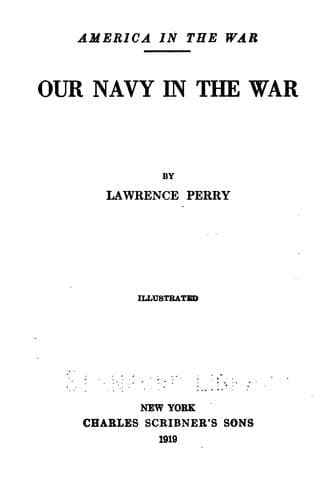
United States. Navy; World War, 1914-1918 -- Naval operations
In view of all that has been said thus far and remains to be said
concerning the submarine, it might be well to digress for a moment and
devote the remainder of this chapter to a consideration of the undersea
fighter, its genesis, what it now is, and what it has accomplished. We
all know that the submarine was given to the world by an American
inventor--that is to say, the submarine in very much the form that we
know it to-day, the effective, practical submarine. The writer recalls
witnessing experiments more than twenty years ago on the Holland
submarine--the first modern submarine type--and he recalls how closely
it was guarded in the early days of 1898, when it lay at Elizabethport
and the Spanish war-ship _Viscaya_, Captain Eulate, lay in our harbor.
This was a month or so after the destruction of the battleship _Maine_
in Havana Harbor, and threats against the Spanish had led, among other
precautions, to an armed guard about the _Holland_ lest some excitable
person take her out and do damage to the _Viscaya_. There was no real
danger, of course, that this would happen; it merely tends to show the
state of public mind.
Well, in any event, the _Holland_, and improved undersea craft
subsequently developed, converted the seemingly impossible into the
actual. To an Englishman, William Bourne, a seaman-gunner must be
credited the first concrete exposition of the possibilities of an
undersea fighter. His book, "Inventions or Devices," published in 1578,
contains a comprehensive description of the essential characteristics of
the undersea boat as they are applied to-day. From the days of the
sixteenth century on down through the years to the present time,
submarine construction and navigation have passed through various stages
of development. Captain Thomas A. Kearney, U.S.N., in an interesting
monograph published through the United States Naval Institute at
Annapolis, says that of the early American inventors, particular mention
should be made of the work of David Bushnell and Robert Fulton, both of
whom have been termed the "father of the submarine." Bushnell's boat,
completed in 1775-6, was much in advance of anything in its class at the
time. The boat, which was, of course, water-tight, was sufficiently
commodious to contain the operator and a sufficient amount of air to
support him for thirty minutes. Water was admitted into a tank for the
purpose of descending and two brass force-pumps ejected the water when
the operator wished to rise. Propulsion was by an oar astern, working as
the propeller of a vessel works to-day. Practically Bushnell in one
attempt to destroy a British war-ship in the Hudson River was able to
get under the British frigate _Eagle_ without detection, but was unable
to attach the mine which the boat carried.
Public-domain text, read in full here on John Shaqi.
Reviews
Reviews
No reviews yet
Be the first to share your thoughts on this work.
Join the Discussion
Join the discussion
Sign in to leave a comment or review.
Sign InorCreate an account