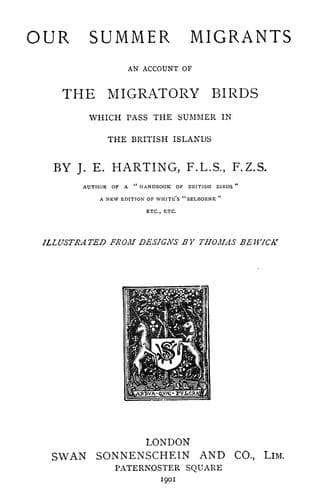
Our Summer Migrants: An Account of the Migratory Birds Which Pass the Summer in the British Islands. — John Shaqi
Our Summer Migrants: An Account of the Migratory Birds Which Pass the Summer in the British Islands.Harting, James Edmund
Science
Our Summer Migrants: An Account of the Migratory Birds Which Pass the Summer in the British Islands.
Harting, James Edmund
Birds -- Great Britain
Although the majority of the _Sylviidæ_ are fruit-eaters, the species
now under consideration are almost entirely insectivorous;[7] they are
also more strictly arboreal in their habits, and as regards the
character of their nests, they differ remarkably from other members of
the _Sylviidæ_ in building domed nests on or near the ground, instead of
cup-shaped nests at a distance from it. The Yellow-billed Chiff-chaff—or
Icterine Warbler, as it should now be called[8]—however, forms an
exception to the rule, as will be seen later. As these little birds make
their appearance at a season when caterpillars and destructive larvæ
begin to be troublesome, the good they do in ridding the young leaves
and buds of these pests is incalculable. I have watched a Willow Wren
picking the green _aphis_ off a standard rose-tree, and have been as
much astonished at the quantity which it consumed as at the rapidity of
the consumption. The Wood Warbler is not nearly so sociable as either
the Willow Warbler or the Chiff-chaff. It keeps to the tops of trees in
woods and plantations, and seldom comes into gardens; hence it is not so
often seen. Although not rare, it is somewhat local, and in the British
Islands, it appears, is confined exclusively to England and the south of
Scotland. Mr. Thompson has included it with hesitation amongst the birds
of Ireland; for although the description given to him of certain birds
and eggs seemed to apply to this species, it was stated that the nest
which contained the eggs was lined with feathers. Now, the Willow Wren
invariably makes use of feathers for this purpose, but the Wood Warbler
does not. The nest of the latter is composed entirely of dry grass and
leaves, occasionally mixed with a little moss; and although I have
sometimes found horsehair inside, I do not remember to have seen or
heard of an instance in which any feathers were employed. The eggs, five
or six in number, are white, closely freckled over with reddish brown.
Public-domain text, read in full here on John Shaqi.
Reviews
Reviews
No reviews yet
Be the first to share your thoughts on this work.
Join the Discussion
Join the discussion
Sign in to leave a comment or review.
Sign InorCreate an account