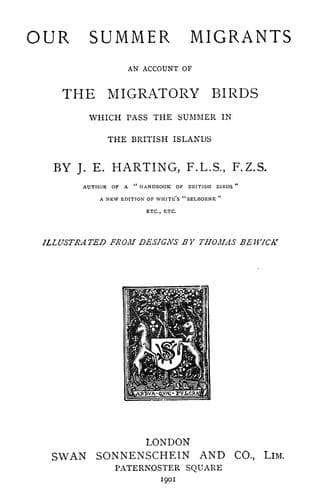
Our Summer Migrants: An Account of the Migratory Birds Which Pass the Summer in the British Islands.Harting, James Edmund
Science
Our Summer Migrants: An Account of the Migratory Birds Which Pass the Summer in the British Islands.
Harting, James Edmund
Birds -- Great Britain
The origin of such an odd notion it is not easy to ascertain, but I
suspect Sir Thomas Browne was not far from the truth when he pointed to
the fact that the Nightingale frequents thorny copses, and builds her
nest amongst brambles on the ground. He inquires “whether it be any more
than that she placeth some prickles on the outside of her nest, or
roosteth in thorny, prickly places, where serpents may least approach
her?”[13]
In an article upon this subject published in the “Zoologist” for 1862
(p. 8029), the Rev. A. C. Smith has narrated the discovery on two
occasions of a strong thorn projecting upwards in the centre of the
Nightingale’s nest. It cannot be doubted, however, that this was the
result of accident rather than design; and Mr. Hewitson, in his “Eggs of
British Birds,” has adduced two similar instances in the case of the
Hedge Sparrow.
The nest of the Nightingale is a very loosely-made structure, composed
for the greater part of dead leaves, and placed upon a hedge bank,
generally at the root of some stout shrub or thorn. The eggs, usually
five in number, are, like the bird itself, of a plain olive-brown
colour. The young Nightingales are spotted like young Robins, having the
feathers of the upper portions of the plumage tipped with buff colour.
In some respects the Nightingale assimilates very much in habits to the
Robin; and advantage has been taken of this in localities where the
Nightingale is unknown to introduce its eggs into the nests of Robins,
with a view to having the young reared in the neighbourhood, and so
induced to return to it. But although, as regards hatching and rearing,
the plan has been successful, the birds have never returned to the place
of their birth. For some inexplicable reason, a limit appears to be set
to the migration of the Nightingale, which has no parallel in the case
of other migrants.
As autumn approaches it moves southwards towards the Mediterranean, and
spends the winter months in North Africa, Egypt, and Asia Minor. We
cannot help thinking that the Nightingale and many other birds which
visit us in summer and nest with us, must also nest in what we term
their winter quarters; otherwise it would be impossible, considering the
immense numbers which are captured on their first arrival, not only in
England, but throughout central and southern Europe, to account for the
apparently undiminished forces which reappear in the succeeding spring.
The late Mr. Blyth, however, was of a different opinion. Criticizing the
above remarks, he wrote:—
Public-domain text, read in full here on John Shaqi.
Reviews
Reviews
No reviews yet
Be the first to share your thoughts on this work.
Join the Discussion
Join the discussion
Sign in to leave a comment or review.
Sign InorCreate an account