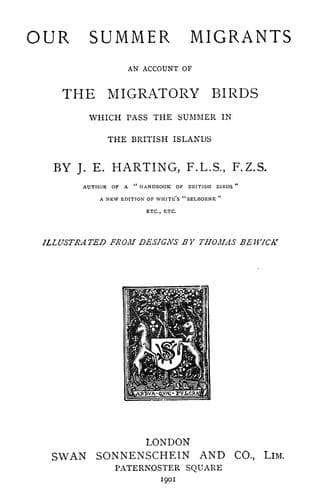
Our Summer Migrants: An Account of the Migratory Birds Which Pass the Summer in the British Islands. — John Shaqi
Our Summer Migrants: An Account of the Migratory Birds Which Pass the Summer in the British Islands.Harting, James Edmund
Science
Our Summer Migrants: An Account of the Migratory Birds Which Pass the Summer in the British Islands.
Harting, James Edmund
Birds -- Great Britain
Leaving the woods, gardens, and plantations, and proceeding to the river
side, we meet with a very different class of birds—the river warblers.
This is a very numerous family, and were we about to treat of all the
known species, it might be advisable for simplicity’s sake to group them
into sub-families. As we are confining our attention, however, for the
present, to those species only which have been met with in the British
Islands, it will be less confusing if we dispense with this subdivision,
and notice them under the same generic name—_Salicaria_. The various
members of this genus may be distinguished by their short wings, rounded
tails, tarsus longer than the middle toe, large feet, long and curved
claws, and large hind toe with strong curved claw. They differ, too,
from other warblers in their habit of singing at night. There are eight
species which have all more or less a claim to be included in the
British list, although three only can be regarded as regular summer
migrants. These three are the Sedge Warbler (_S. phragmitis_), the Reed
Warbler (_S. strepera_), and the Grasshopper Warbler (_S. locustella_).
The others are Savi’s Warbler (_S. luscinoides_), the Aquatic Warbler
(_S. aquatica_), the Marsh Warbler (_S. palustris_), the Great Reed
Warbler (_S. arundinacea_), and the Rufous Warbler (_S. galactoides_).
The Sedge Warbler and the Reed Warbler generally arrive much about the
same time in April, but, from some unexplained cause, the latter is much
more restricted in its distribution than the former. The Sedge Warbler
is found throughout the British Islands, but the Reed Warbler is almost
unknown in Ireland, and its nest has only once been met with in
Scotland.[21] As a rule, it is seldom, if ever, to be seen further north
than Yorkshire and Lancashire, and does not breed either in Devon or
Cornwall. It may thus be said to be almost confined to the eastern,
midland, and south-eastern counties of England. Beyond the British
Islands, too, it is less erratic in its movements than its congeners.
The Sedge Warbler visits Scandinavia, Russia, and Siberia, and is found
throughout Europe in summer, and in North Africa and Asia Minor in
winter. The late Mr. Andersson sent specimens even from Damaraland, S.W.
Africa. The Reed Warbler does not migrate as far north as this; but Mr.
Gurney has received a specimen from Natal; and if we may rely on the
identification of specimens obtained by Mr. Hodgson, it ranges as far
eastward as Nepal.
Public-domain text, read in full here on John Shaqi.
Reviews
Reviews
No reviews yet
Be the first to share your thoughts on this work.
Join the Discussion
Join the discussion
Sign in to leave a comment or review.
Sign InorCreate an account