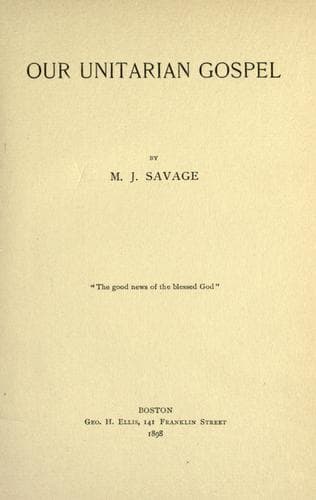
Our Unitarian GospelSavage, Minot J. (Minot Judson)
Religion
Our Unitarian Gospel
Savage, Minot J. (Minot Judson)
Sermons; Unitarianism
As you look over the animal world, which one of them are we accustomed
to think of as coming the nearest to man? What one do we love to have
most with us, to associate most with our joys, with the peace of our
homes? Is it not the dog? And as you examine the dog, study carefully
his nature and characteristics, do you not note that there is in his
nature a hint, a suggestion, of that which is the root of all worship?
The dog is the one animal with which man is accustomed familiarly to
associate himself, who looks up with an incipient reverence, love,
almost worship, to his master. And it is this quality in the dog that
enables him to look up, and, however dimly, feel the life of some one
that is above him, that lifts him into our society, and makes us feel
this tenderness of heart-kinship with that which is finest in his
nature.
And man is man simply because he is able to look above himself. The old
Greeks had an anticipation of that idea when they called man anthropos;
for the meaning of the word is the upward-looker. As in imagination you
go back and down to the time when man first appeared, developed from
the lower life which preceded him, the first thing you can think about
him as human is the opening of his eyes in wonder, the lifting of his
face in curiosity and question, and the birth of adoration in his soul.
This is that which made him man.
You go and study the lowest type of barbaric life to-day; and you will
find that the barbarian has very little curiosity as compared with the
civilized man. You will find that it is very difficult to astonish him
with anything. He does not wonder. He takes everything for granted. He
does not see clearly and deeply enough to appreciate the marvel. Let me
illustrate from a specimen of barbaric life itself. A few years ago the
chief of an Indian tribe was brought from the plains of the West to
visit Washington. The idea was to impress him as much as possible with
the idea of our civilization, so that he might report it to his people
when he went home. After they had crossed the Mississippi on their way
to the West, the gentleman in whose care he was travelling asked the
chief what the one thing which he had seen during his trip was which
had impressed him the most; and he said at once the St. Louis bridge.
But his companion said, Are you not astonished at the Capitol of
Washington? "Yes," he said, "but my people can pile stones on top of
each other; but they cannot make a cobweb of steel hang in the air."
Public-domain text, read in full here on John Shaqi.
Reviews
Reviews
No reviews yet
Be the first to share your thoughts on this work.
Elsewhere in the archive
Join the Discussion
Join the discussion
Sign in to leave a comment or review.
Sign InorCreate an account