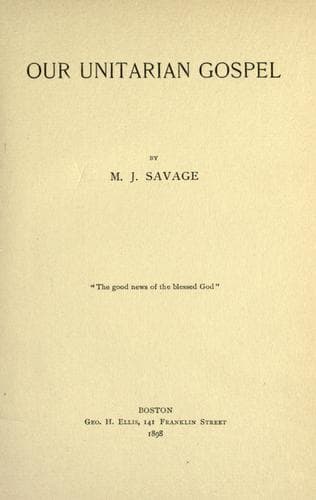
Our Unitarian GospelSavage, Minot J. (Minot Judson)
Religion
Our Unitarian Gospel
Savage, Minot J. (Minot Judson)
Sermons; Unitarianism
You see how that perception lifted him above the average level of his
people? He was showing his capacity for higher and nobler civilization.
It is just this ability in the man to wonder, to see something to
wonder at, to worship, to admire, which lifts him one grade higher than
that of the average level of his tribe. So that which makes man a man
is the capacity in him to admire. All admiration is the essence, the
root, of worship. And, the more things a man admires, the greater and
nobler type of man he is seen to be. If he can admire music, if he can
admire painting, if he can admire sculpture, if he can admire poetry,
if he can admire literature of every kind, if he can admire grand
architecture, the beautiful monuments of the world, we say, Here is a
large, all-round type of man. We estimate his dignity, his greatness,
by the capacity that he shows for worship in its lower type; for
worship is simply looking up with admiration.
There is another quality about this worship that I wish to speak of. It
is the power that is capable of transforming a man, making him over
into the likeness of that which he admires. You find the man without
this capacity, and you know it is hopeless to appeal to him, hopeless
to set up ideals, hopeless to place before him enticing examples. There
is nothing in him to which these things appeal. Take Alexander the
Great. It is said he carried around with him a copy of the Iliad, and
that Achilles was his ideal of a hero. Do you not see how this
admiration transformed the life of the young king, and made him after
the type of that which he admired? It does not make any difference what
this special admiration may be. Let a man admire Beethoven, and he will
cultivate instinctively the qualities that make the beauty and
greatness of Beethoven's character and the wonders of his career.
This ideal may be in a book, it may be embodied in fiction. I have
liked always, either on the walls of my room or on the walls of my
heart, to have certain portraits of persons whom I have loved, who are
no longer living; and they are to me constant stimulus. They speak to
me by day, and in my dreams at night their eyes follow me, and seem to
look into my soul; and in their presence I could not do a mean, an
unmanly thing. I love, I reverence, I worship these lofty ideals. And
the quality of these characters filters down through and permeates the
thought and the life.
You remember how the other aspect of this thought is illustrated by
Shakspere. He says, "My nature is subdued To what it works in, like the
dyer's hand." If that with which you keep company, that you admire, is
below you, it degrades; if it is above you, it lifts. In any case you
are transformed, shaped into the likeness of that which you admire.
Public-domain text, read in full here on John Shaqi.
Reviews
Reviews
No reviews yet
Be the first to share your thoughts on this work.
Elsewhere in the archive
Join the Discussion
Join the discussion
Sign in to leave a comment or review.
Sign InorCreate an account