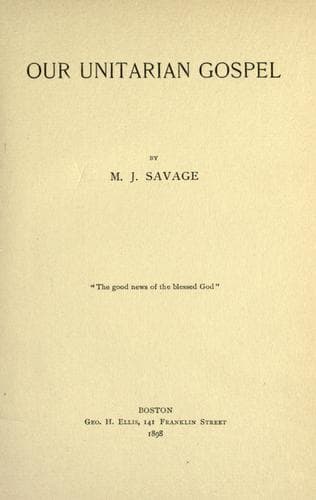
Our Unitarian GospelSavage, Minot J. (Minot Judson)
Religion
Our Unitarian Gospel
Savage, Minot J. (Minot Judson)
Sermons; Unitarianism
And now at the end I wish to suggest what is a theme large enough for a
sermon by itself, and say that these laws of righteousness are so
inherent that they are self-executed; and by no possibility did any
soul from the beginning of the world ever escape the adequate result of
his wrong-doing. The old Hebrews, as manifested in the Book of Job, the
Psalms, and all through the Old Testament, taught the idea, which was
common at that time in the world, that the favor of God was to be
judged by the external prosperity of men and women. The Old Testament
promises long life and wealth and all sorts of good things to the
people who do right; and I find on every hand in the modern world
people who have inherited this way of looking at things. I have heard
people say: I have tried to do right, and I am not prosperous. I wonder
why I am treated so? I have heard women say, I have tried to be a good
mother: why is my child taken away from me? As though there was any
sort of relation between the two facts. I hear people say, Don't talk
to me about the justice of God, when here is a man, who has been
dishonest all his life long, who has prospered, and become rich and
lives in a fine house, drives his horses, and owns a yacht. As if there
was any sort of connection between the two, as though a man merely
because he had a fine house and owned a yacht was escaping the
punishment of his unjust and selfish life.
Remember, friends, look a little below the surface. There is no
possibility of escape. I break some law of my body; do I escape the
result? I break some law of my mind; do I escape the result? I break
some law of my affectional nature; is nothing to happen? I break a law
of my spiritual nature; does nothing take place as the result of it?
You might as well say that the law of gravity can be suspended, that a
man can fling himself over the edge of a precipice, and come to no
harm. The precipice over the edge of which you fling yourself may be a
physical one, may be a mental one, an affectional one, a spiritual one;
but the moral gravity of the universe is never mocked, and the man who
breaks any of God's laws never goes free. He may discover that he has
broken it, be sorry for it, begin to keep it again, and recover
himself; but the consequences are sure, inevitable, eternal.
Public-domain text, read in full here on John Shaqi.
Reviews
Reviews
No reviews yet
Be the first to share your thoughts on this work.
Elsewhere in the archive
Join the Discussion
Join the discussion
Sign in to leave a comment or review.
Sign InorCreate an account