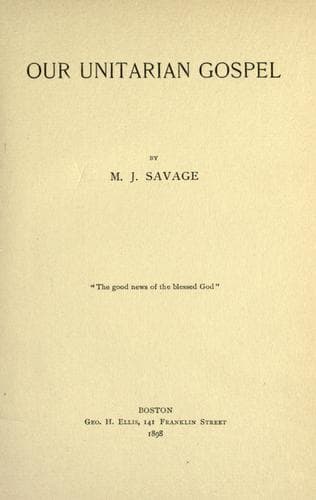
Our Unitarian GospelSavage, Minot J. (Minot Judson)
Religion
Our Unitarian Gospel
Savage, Minot J. (Minot Judson)
Sermons; Unitarianism
You look at a man who is externally prospering, and because of this you
say he is not suffering the result of the evil he has done. Go back
with me to Homer's Odyssey at the time when Ulysses and his companions
fell into the hands of the sorceress, and his companions were turned
into swine. Would you go and look at these swine, and say they are not
suffering anything? See how comfortable they are. See with what gusto
they eat the food that is cast into their troughs. See how happy they
are as swine. They are not suffering anything Is it nothing to become
swinish, merely because you have your beautiful pen to live in? Is a
not suffering the result of his moral wrong when he debases and
degrades and deteriorates his own nature, and becomes less a man,
because he is surrounded with all that is glorious and beautiful that
art can supply? Look within whatever department of nature where the law
has been disobeyed, and there forever and forever read the result, the
inevitable law, that the soul that sinneth, in so far as it sinneth, it
shall die.
REWARD AND PUNISHMENT.
Two WEEKS ago I preached a sermon, the subject of which was "Morality
Natural, not Statutory." Judging by the conversations which I have had
and letters which I have received, it has aroused a good deal of
question and criticism in certain quarters. This must be for one of
three reasons. In the first place, the position which I took may not be
a tenable one. In the second place, it is possible that the views
expressed, being somewhat new and unfamiliar, were not found easy of
apprehension and acceptance. In the third place, it is possible that,
in endeavoring to treat so large a subject, I did not analyze and
illustrate enough to make myself perfectly clear.
At any rate, the matter seems to me of such supreme importance as to
make it worth my while this morning to continue the general subject by
a careful and earnest treatment of the great question of reward and
punishment as applied to feeling, to thought, to conduct, the whole of
human life.
Let me say here at the outset, as indicating the point towards which I
shall aim as my goal, that in the ordinary use of language, in the
popular use of language, I do not believe in either reward or
punishment: I believe only in causes and results. This, as I said, is
the point that I shall aim at. Where shall I begin?
Public-domain text, read in full here on John Shaqi.
Reviews
Reviews
No reviews yet
Be the first to share your thoughts on this work.
Elsewhere in the archive
Join the Discussion
Join the discussion
Sign in to leave a comment or review.
Sign InorCreate an account