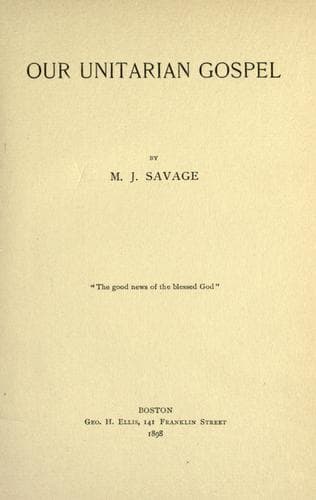
Our Unitarian GospelSavage, Minot J. (Minot Judson)
Religion
Our Unitarian Gospel
Savage, Minot J. (Minot Judson)
Sermons; Unitarianism
But the thing that engages our attention this morning is not its power
as a dramatic production, but its criticism of God's government of the
world. It has been assumed, as I have said, and we are not through with
that assumption, that, if a man suffered, if he was ill, if his wife or
children were taken away from him, if his property was destroyed,
somehow he had offended God, and that this was a punishment for the
course of wrong-doing in which he had been engaged. But the author of
the Book of Job conceives that this does not quite match the facts; so
he gives us this magnificent character that he declares upright,
spotless, free from wrong of any kind, who yet is suffering. He has
lost his property, it has been swept away, his children have been put
to death, almost everything that he cared for he has lost, and he from
head to feet is sick of a loathsome disease; and he sits in the midst
of his deprivation and sorrow. His friends gather around him; and with
this old assumption in their minds some of them begin to taunt him.
They say, Now, Job, why not confess, why not own up as to what you have
been doing? Of course, you have been doing something wrong, or all this
would not have happened. This is the tone that one of his critics
takes. This is the kind of comfort that he receives in the midst of his
sorrow. But Job protests earnestly and indignantly that it is not true.
He says he is innocent, there are no secret wrongs in his life; and he
wishes that he might find some way by which he could come into the
presence of the great Ruler of the universe, and openly plead his
cause. But his friends do not believe him.
Now the writer of the book lets us into the explanation he has thought
out for this: God for a special reason is testing Job, to see whether
he will be true to him in spite of the fact that he does not get the
ordinary blessings that the people were accustomed to look for as the
rewards of their conduct. But the writer is not consistent with the
wonderful position that he makes Job assume; for, after the trial is
all over, he falls in with the popular theory, and shows us Job, not
with the old children who could not be brought back, but with a lot of
new ones, with herds and cattle again in plenty, with honor among his
fellow-citizens, with all that heart could wish in the way of worldly
prosperity and peace.
So I say the writer is not quite consistent, for he falls back at the
end on the old theory, and he lets us gain a glimpse behind the scenes,
just enough to see that there are cases, special cases, where the
popular theory does not hold; but he still seems to assume that, in a
general way, we are to accept it as correct, and as explaining the
facts of human life.
Public-domain text, read in full here on John Shaqi.
Reviews
Reviews
No reviews yet
Be the first to share your thoughts on this work.
Elsewhere in the archive
Join the Discussion
Join the discussion
Sign in to leave a comment or review.
Sign InorCreate an account