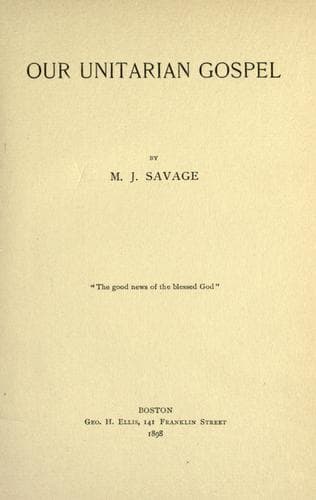
Our Unitarian GospelSavage, Minot J. (Minot Judson)
Religion
Our Unitarian Gospel
Savage, Minot J. (Minot Judson)
Sermons; Unitarianism
Is this way of looking at it confined to primitive man, confined to
pagan nations? Do we find something else, some other condition of mind,
when we come to study carefully the Old Testament? Let us see. Take the
first verse which I read as a part of my text. The author of this Psalm
we do not know who he may have been says, "I have been young, and now
am old; yet have I not seen the righteous forsaken, nor his seed
begging their bread." As I have read this a great many times in the
past, I have wondered as to the strange experience that this man must
have had in human life, if this is a correct interpretation of that
experience. I have been young: I do not like to admit that as yet I am
old; but, whether I am or not, I have a good many times seen the
righteous forsaken, and his seed begging their bread.
It seems to me that the writer of this verse was trained in a theory of
the government of human affairs that does not at all match the facts.
He has this magical, this arbitrary theory in his mind. It was the
general conception I think, as any one will find by a careful reading
of the Old Testament or study of Jewish history, the ordinary
conception among the Hebrews, that God was to reward people for being
good by prosperity, long life, many children, herds of cattle,
distinction among his fellow-men, positions of political honor and
power; and the threat of the taking away of these is frequently uttered
against those that presume to do wrong. In other words, it seems to me
that the ordinary theory of the government of human affairs as set
forth in the Old Testament is precisely this same one that I have been
considering as the natural and necessary outcome of the ignorance and
inexperience of early man.
As time went on, now and then some deeper, more spiritual thinker
begins to question this method of reasoning, begins to wonder whether
it is quite adequate; and we have a magnificent poetical expression of
this kind of critical thought in the Book of Job. This Book of Job is
any way and every way worthy of your careful attention. It is the
nearest to a dramatic production of anything in the Bible. James
Anthony Froude said once in regard to it that, if it were translated
merely as a poem and published by itself, it would take rank as a
literary work among the few great masterpieces of the world.
Public-domain text, read in full here on John Shaqi.
Reviews
Reviews
No reviews yet
Be the first to share your thoughts on this work.
Elsewhere in the archive
Join the Discussion
Join the discussion
Sign in to leave a comment or review.
Sign InorCreate an account