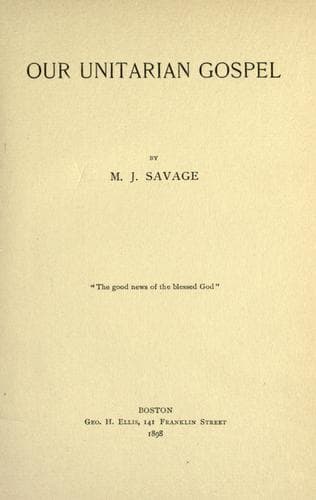
Our Unitarian GospelSavage, Minot J. (Minot Judson)
Religion
Our Unitarian Gospel
Savage, Minot J. (Minot Judson)
Sermons; Unitarianism
Now let us look into the matter a little deeply; and let us see if we
can find any hint of light and guidance. I have had a person within a
week say to me, "I do not feel at all sure that it means much that
people get the moral results of their moral action in a particular
department of life. If a person becomes a little bit callous and hard,
wisely selfish and prudent, and so prospers in the affairs of this
life, I am not sure that he is not as well off as anybody, perhaps a
little better off, perhaps a little better off than a person who is
sensitive, and worries because he does not reach his ideals; and it is
possible that he serves the world after all quite as well." This is a
kind of criticism, I say, that has been made to me in the last week.
Let us look at it for just a minute. People do not seem able as yet to
understand that a man is really "punished," in the popular sense of
that word, unless they can see him publicly whipped. It does not seem
to them to mean anything because a man deteriorates, because the
highest and finest qualities in him atrophy and threaten to die out. I
used an illustration in my sermon two weeks ago to which I shall have
to recur again, to see if I can make it mean more than it did then. It
is the story of Ulysses who fell into the hands of the famous
sorceress, and whose companions were turned into swine. Now would you
be willing to be turned into a pig, merely because, being a pig, you
would not know anything about it, and would not suffer? Would you be
willing to be reduced to the life of an oyster, merely because, being
an oyster, you would be haunted by no restless ideals, and, so far as
you had any sense at all, would probably be very comfortable indeed? Is
there no "punishment" in this deprivation of the highest and finest
things that we can conceive of?
It seems to me that a person who has deteriorated, who has become
selfish, who has become mean, who has lost all taste for high and fine
and sweet things, and is unconscious of them, is having meted out to
him the worst conceivable retribution. If a man is mean and knows it,
if a man is selfish and is conscious of it, if a man is unjust and is
stung by the reflection, there is a little hope for him, there is life
there, there is moral vitality, there is a chance for him to
recuperate, to climb up into something higher and finer; but, if he has
not only become degraded and mean, but has become contented in that
condition, it seems to me that he is worse off than almost anybody else
of whom we can dream.
Public-domain text, read in full here on John Shaqi.
Reviews
Reviews
No reviews yet
Be the first to share your thoughts on this work.
Elsewhere in the archive
Join the Discussion
Join the discussion
Sign in to leave a comment or review.
Sign InorCreate an account