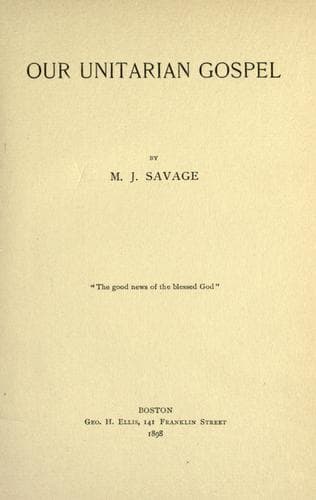
Our Unitarian GospelSavage, Minot J. (Minot Judson)
Religion
Our Unitarian Gospel
Savage, Minot J. (Minot Judson)
Sermons; Unitarianism
Let us see for a moment on what conditions a man who has deteriorated
is well off. There are three big "ifs" in the way, in my thought of it.
If a man really is a spiritual being, if he is a child of God, if there
are in him possibilities of unfolding of all that is sweet and divine,
then he is not well off when he is not developing these, and is content
not to develop them. Browning says, in his introduction to "Sordello,"
"The culture of a soul, little else is of any value."
If we are souls, and if the culture of a soul is of chiefest
importance, then cursed beyond all words is the man who has
deteriorated and become degraded and is content to have it so. Blessed
beyond all words is the soul that is haunted by discontent, haunted by
unattained and unattainable ideals, who is restless because of that
which he feels he might be and yet is not, he who is touched by the
far-off issues of divinity, and cannot rest until he has grown into
the stature of the Divine!
And then, once more, if it be true that it is worth our while to help
our fellow-men in the higher side of their nature, to help them be men
and women, to help them realize that they are children of God, and to
grow into the realization of it, if, I say, this be worth while, then
lamentable beyond all power of expression is the condition of that man
who does not feel it and does not care for it, and does not consecrate
himself to its attainment. Look over the long line of those who have
served mankind. Who are they? From Abraham down, the prophets of
Israel; Jesus, Paul, Savonarola, Huss, Wyclif, Luther, Channing,
Parker, who have these men been but the ones who were ready at any
price to do something to lift up and lead on the progress of mankind?
These are the ones who have felt the meaning of those sublime words of
Jesus: "He that loseth his life shall save it." If there is any meaning
in that splendid passage from George Eliot, that is so trite because it
is so fine,
"Oh may I join the choir invisible
Of those immortal dead who live again
In minds made better by their presence: live
In pulses stirred to generosity,
In deeds of daring rectitude, in score
For miserable aims that end with self,
In thoughts sublime that pierce the night like stars,
And with their mild persistence urge man's search
To vaster issues.
So to live is heaven:
To make undying music in the world,
Breathing as beauteous order that control
With growing sway the growing life of man.
This is life to come,
Which martyred men have made more glorious
For us who strive to follow.
May I reach That purest heaven, be to other souls
The cup of strength in some great agony,
Enkindle generous ardor, feed pure love,
Beget the smiles that have no cruelty,
Be the sweet presence of a good diffused,
And in diffusion ever more intense.
So shall I join the choir invisible
Whose music is the gladness of the world."
Public-domain text, read in full here on John Shaqi.
Reviews
Reviews
No reviews yet
Be the first to share your thoughts on this work.
Elsewhere in the archive
Join the Discussion
Join the discussion
Sign in to leave a comment or review.
Sign InorCreate an account