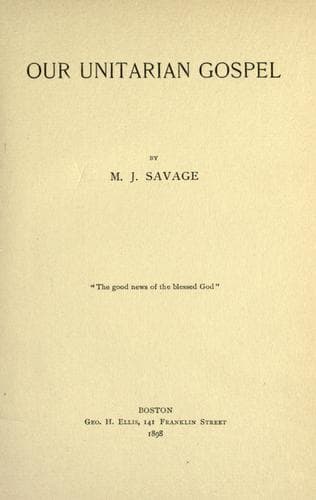
Our Unitarian GospelSavage, Minot J. (Minot Judson)
Religion
Our Unitarian Gospel
Savage, Minot J. (Minot Judson)
Sermons; Unitarianism
If, I say, there is any meaning in that magnificent song, then indeed
it is worth while to be miserable, if need be, worth while to suffer,
worth while to sacrifice for the sake of planting seed in the spiritual
fields, and looking for its spiritual results, and not finding fault
with the universe because we do not get results of spiritual goodness
in material realms.
There is one other "if." If it be true, as I believe it is, that this
life goes right on, and that we carry into the to-morrow of another
life the precise and accurate results that we have wrought out in the
to-day of this; if it be true that, when we get over there, it will be
spiritual facts and spiritual things with which we shall deal, then the
man who has cultivated his spiritual nature and has reaped spiritual
results has no right to find fault with the universe because it has not
paid him with material good.
Let us remember, then, that we get what we sow. God has not promised to
pay you in greenbacks for being good; God has not promised to give you
physical health because you are gentle and tender; God has not promised
to give you long life because you are generous; God has not promised to
give you positions of social or political honor because you are kind to
your neighbors, faithful to your wife, true to your children. Can you
not see that whatsoever a man sowest, that shall he reap; and that he
will reap in the field where he sows, and not in some other; and that
God is dealing fairly, justly, tenderly, truly, with you in giving you
the results at which you aim, and not the results at which you do not
aim?
So, if you really care to be a man, if you care to be a woman, honest,
noble, tender, true, then be these, and be grateful that you reap the
reward where you sowed, and do not find fault with God or the universe
because he does not pay you for things that you have not done, because
he does not make a crop grow in some field that you have not
cultivated, because it is eternally true that God is not mocked, and
that whatsoever a man soweth, that shall he also reap.
THINGS WHICH DOUBT CANNOT DESTROY.
THE critical and investigating work of the modern world threatens to
shake not the earth only, but also heaven. And there are large numbers
of people who are disturbed and afraid: they are troubled lest certain
things that are precious, that are dear to them, may be taken away. Not
only this, they are troubled lest things of vital importance to the
highest life of the world be taken away. I propose, then, this morning
to run in rapid review over a few of the changes that are caused by the
investigating spirit of the time, and then to point out some things
that are not touched, that cannot be shaken, and that therefore must
remain. And I ask you to have in mind, as I pursue this line of
thought, the question whether doubt has taken away anything really
valuable from mankind. The negative part of my theme I shall touch on
very lightly, and dispose of as briefly as I may.
Public-domain text, read in full here on John Shaqi.
Reviews
Reviews
No reviews yet
Be the first to share your thoughts on this work.
Elsewhere in the archive
Join the Discussion
Join the discussion
Sign in to leave a comment or review.
Sign InorCreate an account