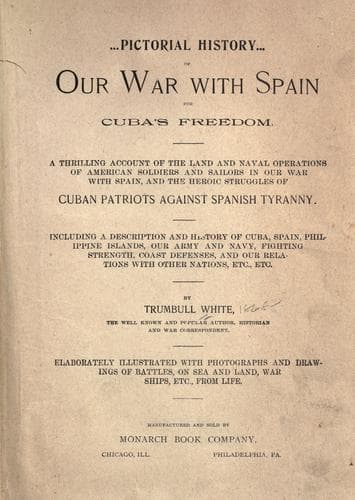
Our War with Spain for Cuba's FreedomWhite, Trumbull
History
Our War with Spain for Cuba's Freedom
White, Trumbull
Cuba -- History; Spain -- Foreign relations -- United States; Spanish-American War, 1898; United States -- Foreign relations -- Spain
Mr. Clarence King, a recognized authority on political subjects
connected with Cuban affairs, says:
"The main concession for which the insurgents accepted peace was the
promise of constitutional reform. As a matter of fact, there promptly
followed four royal edicts as follows: June 9, entitling Cuba to elect
deputies to the Cortes, one for each 40,000 people; June 9, dividing the
island into the present six provinces; June 21, instituting a system of
provincial and municipal government, followed on August 16 by the
necessary electoral regulations. But the system was immediately seen to
be the shadow without the substance of self-government. The Provincial
Assembly could nominate only three candidates for presiding officer. It
was the inevitable governor-general who had the power to appoint, not
necessarily one of the three nominees, but any member of the Assembly he
chose. But all this provincial machinery is in reality an empty form,
since expressly by law the governor-general was given the power to
prorogue the assemblies at will. The deputies have never been able to
accomplish anything in the Cortes. Moreover the crux of the whole
financial oppression--tariff, taxes, and absolute control and
expenditure of the revenue--remained with Spain."
The loyal Spaniard insists that every agreement entered into by
his government was faithfully carried out; that the Cubans were
given from time to time even greater liberties than the treaty
promised them; and that in several matters of importance,
immunities have been granted them that the people of the mother
country did not share.
The Assistant Colonial Secretary of Spain concludes a voluminous
defense of the policy of his government in Cuba as follows:
There is thus no reason in Cuba to complain of the illiberality of
the laws. If there has been any shortcoming in respect to morals,
the nation is not to blame; none but the colonial provinces are to
blame for this; if we proposed to seek comfort in comparisons, it
would not be necessary to look for them in South America, in the
countries that have emancipated themselves from the Spanish
mother-country, because examples (some of them very recent) of
acts of violence, anarchy and scandalous outbreaks could be found
in the States of the Union itself.
Public-domain text, read in full here on John Shaqi.
Reviews
Reviews
No reviews yet
Be the first to share your thoughts on this work.
Elsewhere in the archive
Join the Discussion
Join the discussion
Sign in to leave a comment or review.
Sign InorCreate an account