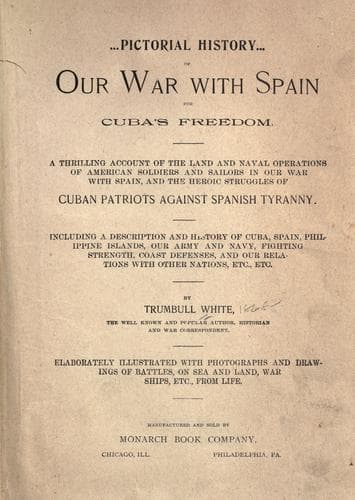
Our War with Spain for Cuba's FreedomWhite, Trumbull
History
Our War with Spain for Cuba's Freedom
White, Trumbull
Cuba -- History; Spain -- Foreign relations -- United States; Spanish-American War, 1898; United States -- Foreign relations -- Spain
In respect to another matter, a great deal of foolish talk is
indulged in. From the statements of some people it would appear
that Cuba does nothing but contribute, by the taxes which it pays,
to alleviate the burdens of the peninsular treasury, whereas, in
reality, just the contrary is the truth. The nation has, of late,
guaranteed the conversion of Spanish debts in Cuba, which took
place in 1886 and 1890. Owing to these operations, and to the fact
that all taxes which did not have to be met directly by its
government have been rigorously eliminated from the budget of
Cuba, it was possible to reduce the Cuban budget from forty-six
and one-half million dollars, which was its amount at the close of
the former war (for the fiscal year of 1878-79) to a little more
than twenty-three millions of dollars, as appears from the budget
of 1893.
The financial laws have been assimilated, and if the system of
taxation has not been entirely assimilated, this is because of the
fact that direct taxes are very repugnant to the popular feeling
in Cuba, especially the tax on land, which is the basis of the
Peninsular budget. It appears, however, that our Cuban brethren
have no reason to complain in this respect. The direct tax on
rural property is two per cent, in Cuba, whereas in Spain it is
seventeen, and even twenty per cent. It is evident that every
budget must be based on something; in Cuba, as in all other
countries in which the natural conditions are similar, that
something must necessarily be the income from customs duties.
Notwithstanding this, it may be remarked that in the years when
the greatest financial distress prevailed, the Spanish Government
never hesitated to sacrifice that income when it was necessary to
do so in order to meet the especial need of the principal
agricultural product of Cuba. Consequently the Spanish commercial
treaty with the United States was concluded, which certainly had
not been concluded before, owing to any fault of the Spanish
Government. Under that treaty, the principal object of which was
to encourage the exportation of Cuban sugar, which found its chief
market in the States of the Union, many Spanish industries were
sacrificed which have formerly supplied the wants of the people of
Cuba. That sacrifice was unhesitatingly made, and now that the
treaty is no longer in force, is due to the fact that the new
American tariff has stricken sugar from the free list.
Attention may also be called to the fact that the colonial
provinces alone enjoy exemption from the blood tax, Cuba never
having been obliged to furnish military recruits.
Public-domain text, read in full here on John Shaqi.
Reviews
Reviews
No reviews yet
Be the first to share your thoughts on this work.
Elsewhere in the archive
Join the Discussion
Join the discussion
Sign in to leave a comment or review.
Sign InorCreate an account