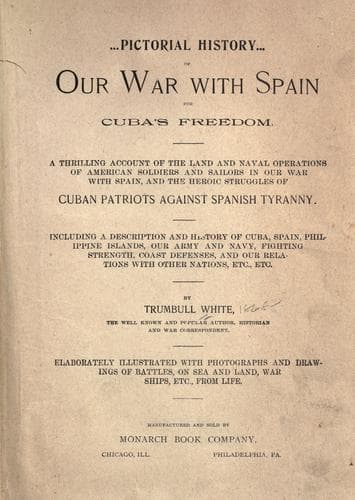
Our War with Spain for Cuba's FreedomWhite, Trumbull
History
Our War with Spain for Cuba's Freedom
White, Trumbull
Cuba -- History; Spain -- Foreign relations -- United States; Spanish-American War, 1898; United States -- Foreign relations -- Spain
The Cuban exiles in Key West, New York and other cities in the
United States, and in Costa Rica, Honduras, Santo Domingo and
other parts of Spanish America, had been planning a new uprising
for several years. The desire of the Cubans for national
independence was quickened by what they suffered from Spain's
misgovernment. For two or three years the exiles in the United
States and Spanish American countries, veterans of the war of
1868-78, and younger champions of free Cuba, organized clubs,
collected a war fund, purchased munitions of war and laid plans
with their compatriots in Cuba for a new struggle for
independence. There were 140 revolutionary clubs in North and
South America, Cuba and other West India islands, affiliated under
the name of the revolutionary party, ready to support an uprising
with financial and moral aid. Cuban workingmen in the United
States promised to contribute a tenth of their earnings, or more
if necessary. There were firearms on the island that had remained
concealed since the former war, some had been bought from corrupt
custodians of the government arsenals, who, finding it impossible
to get pay due them from Spain, took this method of securing what
was rightfully theirs.
AN EXPEDITION CHECKED.
An expedition that planned to sail in the yacht Lagonda from
Fernandina, Fla., on January 14, 1895, was broken up by the United
States authorities. General Antonio Maceo, its leader, with Jose
Marti, the political organizer of the new government, went to
Santo Domingo, where they could confer with the revolutionist
leaders living in Cuba. There Marti found Maximo Gomez, the
veteran of a dozen struggles and a brave and able soldier, and
offered him the command and organization of the army. Gomez
accepted and began at once to arrange his programme.
The plan of the revolutionists was to rise simultaneously in the
six provinces on February 24. The leaders on the island and the
organizers abroad had a thorough understanding.
HEROISM OF CUBAN WOMEN.
The men of Cuba were not alone in their plans for independence,
for their wives and sisters, mothers and sweethearts, were
enthusiastic and faithful allies. The island was full of devoted
women reared in indolence and luxury who were tireless in their
successful efforts to get word from, one scattered rebel band to
another, and to send them food, medicines and clothing. These
women were far better conspirators than their fathers and
brothers, for Cuban men must talk, but the women seem to know the
value of silence.
Public-domain text, read in full here on John Shaqi.
Reviews
Reviews
No reviews yet
Be the first to share your thoughts on this work.
Elsewhere in the archive
Join the Discussion
Join the discussion
Sign in to leave a comment or review.
Sign InorCreate an account