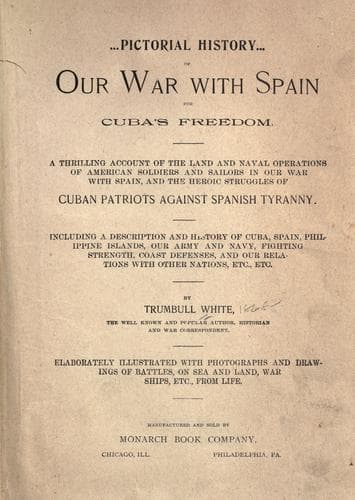
Our War with Spain for Cuba's FreedomWhite, Trumbull
History
Our War with Spain for Cuba's Freedom
White, Trumbull
Cuba -- History; Spain -- Foreign relations -- United States; Spanish-American War, 1898; United States -- Foreign relations -- Spain
The Cuban Treasury, between 1823 and 1864, sent to Spain
$82,165,436 in gold. This money entered the Spanish Treasury as
"Colonial surplus," but as a Spanish writer (Zaragoza) says in his
book, "Las Insurrecciones de Cuba," it was absurd to speak of a
surplus when not even the opening of a bad road was undertaken.
Politically, the condition of the Cubans after the restoration of
peace in 1878, was as bad as it had been before. Laws existed
which might lead unobserving persons to believe that the Cubans
enjoyed every liberty, but as a matter of fact the Cubans were
kept under the most unbearable vassalage. The Spaniards in Cuba
before this war numbered only 9.30 per cent of the island's
population, but, availing themselves of a law which gave to them a
majority in the electoral census, they were to return twenty-four
of the thirty deputies which the island then sent to the Spanish
Cortes.
So restrictive was the electoral law that only 53,000 men were
qualified to vote in the entire island, although its population
was 1,762,000. In the municipal district of Guines, with a
population of 12,500 Cubans and 500 Spaniards, the electoral
census included 400 Spaniards and thirty-two Cubans. This is one
among many similar instances. The Board of Aldermen in Havana, the
capital city of the island, has for years been made up entirely of
Spaniards, and the same may be said of Cienfuegos and other
important cities.
Despite all constitutional provisions the governor-general of the
island had the power to deport from the island, without a trial,
any person whose presence there he considered dangerous to the
security of the State. The island was at peace when Cepeda, Lopez
de Brinas and Marquez Sterling, all journalists, were deported.
The liberty of the press was and still is a myth. El Pais, the
Autonomist organ, was criminally prosecuted in 1889 because it
denounced the appointment of one of the sons of the president of
the Havana Court of Appeals to a place which he could not lawfully
hold.
What liberty of association the Cubans enjoyed may be judged from
the fact that a delegate of the government had to be present at
their meetings, with power to dissolve them whenever he saw fit to
do so.
No Cuban was able to obtain a place in the administration unless
he was rich enough to go to Madrid and there become acquainted
with some influential politician. Even so, Cubans seldom succeeded
in being appointed to places of importance.
Public-domain text, read in full here on John Shaqi.
Reviews
Reviews
No reviews yet
Be the first to share your thoughts on this work.
Elsewhere in the archive
Join the Discussion
Join the discussion
Sign in to leave a comment or review.
Sign InorCreate an account