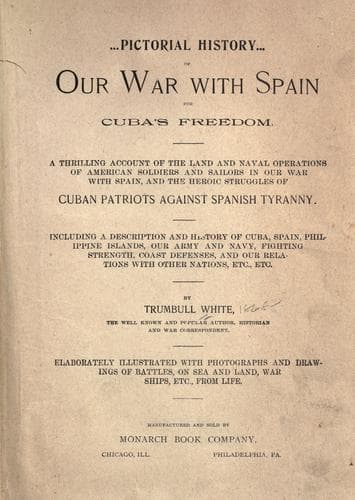
Our War with Spain for Cuba's FreedomWhite, Trumbull
History
Our War with Spain for Cuba's Freedom
White, Trumbull
Cuba -- History; Spain -- Foreign relations -- United States; Spanish-American War, 1898; United States -- Foreign relations -- Spain
The Junta, whose duty it has been to provide the funds for the
carrying on of the war, has had various sources of income, all of
them distinctly creditable, both to the integrity of the Cuban
authorities and to the sentiments of those who have contributed
the money. The larger portion of the cash has come in small
contributions from Cubans living in the United States. The
cigarmakers of Key West, Tampa, Jacksonville, New York and other
cities where large Cuban colonies have congregated, have proven
their patriotism and their adherence to the cause by giving more
generously of their earnings than has ever been done before by the
people of any country struggling for freedom. There is scarcely an
exception to the assertion that every Cuban in America has shared
in contributions to the war fund.
The minimum contribution has been ten per cent of the weekly
earnings, and this has brought an enormous sum into the coffers of
the Junta for war purposes. It is true that a war chest of $50,000
or $100,000 a week would be hardly a drop in the bucket for the
conduct of the war after the established methods of organized
armies. But this has been a war for liberty, and the conditions
have been unique. No soldier in all the armies of Cuba Libre has
ever drawn one dollar of pay for his service. Thousands of them
have been fighting from the first outbreak of insurrection,
without receiving a cent of money for it. If the pay of an army be
deducted from the expenses of a war, the largest item is saved.
Nor has it been necessary to purchase many clothes, owing to the
mildness of the Cuban climate, which fights in favor of those who
are accustomed to it. The commissary department, too, has been
almost non-existent, and the soldiers in the field have lived by
foraging and by collecting the vegetables and fruits saved for
them by the women and children, whose hearts are as deep in the
conflict as are their own. The principal demand for money has been
to procure arms, ammunition and medical and surgical supplies.
In addition to the contributions which have come from patriotic
Cubans, another large source of income to the Junta has been the
silent liberality of many American citizens, who have proved their
practical sympathy to the cause of freedom by giving of their
wealth to aid it. Outside of these sources, the only income has
been from the sale of bonds of the Cuban republic, a means of
obtaining money which has been used conservatively, so that the
infant republic should not be saddled with a heavy debt at the
outset of its career as an independent nation.
Aside from the contributions of money to the Cuban powers,
enormous quantities of medical and surgical supplies and hospital
delicacies have been offered by the generous people of the United
States, organized into Cuban Auxiliary Aid Societies in the
various cities of the country. American women have taken a
prominent part in this movement and have won thereby the undying
gratitude of the Cubans.
Public-domain text, read in full here on John Shaqi.
Reviews
Reviews
No reviews yet
Be the first to share your thoughts on this work.
Elsewhere in the archive
Join the Discussion
Join the discussion
Sign in to leave a comment or review.
Sign InorCreate an account