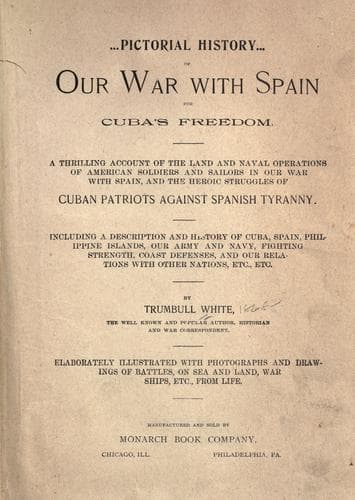
Our War with Spain for Cuba's FreedomWhite, Trumbull
History
Our War with Spain for Cuba's Freedom
White, Trumbull
Cuba -- History; Spain -- Foreign relations -- United States; Spanish-American War, 1898; United States -- Foreign relations -- Spain
SOME FACTS ABOUT FILIBUSTERING.
The sailing of vessels from New York and other ports with cargoes
of supplies for the Cuban revolutionists has been a frequent
occurrence, far more so than has been known to the public.
Filibustering is a phrase that has gained honor during these three
years, such as it never had before. Carried on in the cause of
humanity and liberty, its motives justified its irregularities,
and there have been few to condemn the practice. In the fogs of an
early morning, some fast steamer would slip away from an Atlantic
port, loaded with arms, ammunition, quinine, and all sorts of
hospital, medical and surgical supplies, accompanied usually by a
band of Cuban patriots, seeking the first opportunity to return to
their beautiful island and take up arms for its liberation. There
have been a few such expeditions captured, but for everyone
captured a score have reached their destination on the Cuban coast
without interruption, and have landed their cargo in safety in
insurgent camps.
The United States government, in recognition of its diplomatic
obligations, spent millions of dollars prior to the outbreak of
our war with Spain, in carrying on a patrol service of the
Atlantic coast and the Gulf of Mexico, to prevent the sailing of
filibustering expeditions. Now that the day of such patrol service
in the aid of Spain is ended forever, there can be no harm in
telling some of the details that might have been compromising
before.
American cruisers and gunboats were stationed in the harbors
around the coast, from New York to New Orleans, and particularly
on both sides of the Florida peninsula. To one of these vessels
would come the news that a suspected filibustering craft was
likely to sail from a certain place at a certain time, and orders
would be given to intercept the rover if possible. To one who did
not know the temper and the spirit of American sailors from
highest to lowest in the service of the navy, the actions that
followed might have been puzzling. In spite of the proverbial
alacrity and readiness with which an American vessel can make
sail, there was always a delay at such times. It was almost
certain that something would be wrong that would require some time
to correct before the anchor could be weighed. It might be
necessary to buy provisions or to take on coal before sailing, and
then, more than once after the anchor was weighed and the actual
start begun, it would be discovered that some minor accident had
occurred to the machinery, which would require another halt to
repair it. Finally at sea, the cruiser would steam away at full
speed in the direction of the reported filibuster, until her hull
and even her smoke disappeared far down in the horizon.
CAPTURING OF FILIBUSTERING VESSELS.
Public-domain text, read in full here on John Shaqi.
Reviews
Reviews
No reviews yet
Be the first to share your thoughts on this work.
Elsewhere in the archive
Join the Discussion
Join the discussion
Sign in to leave a comment or review.
Sign InorCreate an account