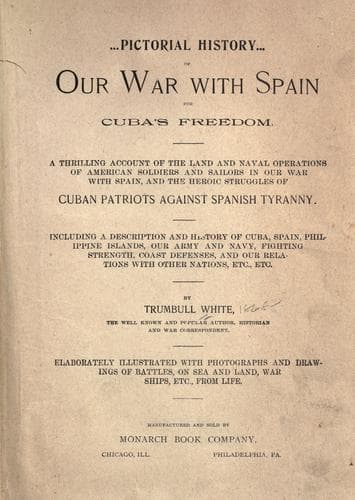
Our War with Spain for Cuba's FreedomWhite, Trumbull
History
Our War with Spain for Cuba's Freedom
White, Trumbull
Cuba -- History; Spain -- Foreign relations -- United States; Spanish-American War, 1898; United States -- Foreign relations -- Spain
"Let those who can put an end to this war reflect that our liberty
is being gained with the blood of thousands of Cuban victims,
among whom is numbered Jose Marti, the apostle and martyr of our
revolution. Let them consider that before the sacred memory of
this new redeemer there is not a single Cuban who will withdraw
from the work of emancipation without feeling ashamed of
abandoning the flag which on the 24th of February, 1895, was
raised by the beloved master.
"It is time for the Cuban people to satisfy their just desire for
a place among the free nations of the world and let them not be
accused if to accomplish their noble purpose they are obliged to
reduce to ashes the Cuban land.
Tomas Estrada Palma."
CHAPTER XVIII.
KEY WEST AND THE CUBANS.
Cuban Refugees in Key West--Their Devotion to the Cause--
Peculiarities of the Town--Odd Sights and Sounds--Filibusters and
Their Work--The First Authorized Expedition--It Is a Failure--The
Second More Successful--Landing Supplies for the Insurgents--
Captain Jose Lacret, and Some of His Adventures.
The island of Key West lies sixty miles south of Cape Sable, the
most southerly point of the mainland of Florida, and is seven
miles long and from one to two miles broad. The city covers nearly
one-half of the island and has a population of about 25,000. Key
West has been described as being "to Cuba what Gibraltar is to
Ceuta, to the Gulf of Mexico what Gibraltar is to the
Mediterranean." It is one of the chief naval stations of the
United States and is strongly fortified.
The most important industry is the making of cigars, which gives
employment to thousands of Cubans, who make up a large majority of
the population, and many of whom are refugees, charged with
political crimes, with a price set upon their heads. One of the
most important divisions of the Cuban Junta of the United States
has its headquarters here. Almost every Cuban in Key West gives
regularly a portion of his earnings to the cause, and many cargoes
of arms, ammunition and supplies have been sent to the insurgents
by their brethren on this little island. The city is unique in
many respects. It is made up of innumerable little wooden houses,
without chimneys, but crowded in irregular groups. Many of the
houses have wooden shutters in place of glass windows.
On most of the streets there are no sidewalks, but people stumble
over the jagged edges of coral rock. There are a great number of
public vehicles, and one can be hailed at any corner and engaged
for 10 cents. Some of these carriages are quite respectable in
appearance. They are generally double-seated affairs, which have
been discarded in the north. The horses are wrecks, and they show
by their appearance that fodder is dear and that they are not half
fed.
One of the sounds of Key West is the whacking of the horses which
draw the carriages and the mules which move the street cars from
place to place.
Public-domain text, read in full here on John Shaqi.
Reviews
Reviews
No reviews yet
Be the first to share your thoughts on this work.
Elsewhere in the archive
Join the Discussion
Join the discussion
Sign in to leave a comment or review.
Sign InorCreate an account