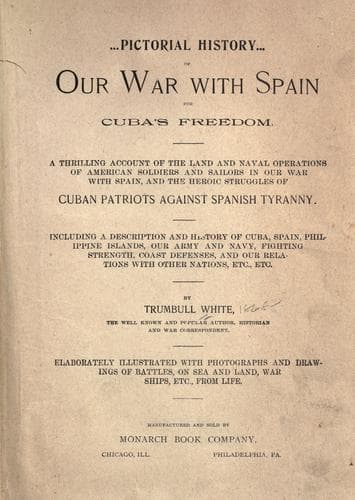
Our War with Spain for Cuba's FreedomWhite, Trumbull
History
Our War with Spain for Cuba's Freedom
White, Trumbull
Cuba -- History; Spain -- Foreign relations -- United States; Spanish-American War, 1898; United States -- Foreign relations -- Spain
The street cars look as if they had been dug up from the
neighborhood of the pyramids. Ropes are used for reins, and the
only substantial thing about the whole outfit is the great rawhide
whip, with which the street-car driver labors incessantly. The
people, as a rule, are opposed to excessive exertion, but they
make an exception in the case of labor with a whip.
JOURNALISM, CLIMATE AND DOGS.
The town has one struggling newspaper, which is worthy of a better
support. It is told of the editor that he came to Key West a
barefooted boy from Georgia, and worked his way up to his present
eminent position of instructor in etiquette and ethics to the four
hundred.
Hundreds of dogs, cats, roosters, goats, and "razorbacks" run at
large through the streets, and the three former combine to make
night hideous. In the early evening the sound of negro meetings
and jubilations predominates. Then the cats begin where the
shouters leave off. Later, the dogs, sneaking and sore-eyed, and
more numerous than any other species, take up the refrain. They
howl and bark and keep on howling and barking, until sleep seems
impossible. At last, when the wakeful man thinks the row is over,
the roosters, the meanest, skinniest, loudest-mouthed roosters in
the world, continue the serenade until death seems a welcome,
especially the death of the roosters.
NEGROES ALONE ARE PATRIOTIC.
There is a strange mixture of races at Key West, but the negroes
are the most patriotic class. They alone celebrate the Fourth of
July and other national holidays. While the town has its
enlightened and respectable people, it also has a shoddy class,
whose ignorance of the rest of the world carries them to grotesque
extremes in their efforts to proclaim their greatness.
Even in its schools Key West is peculiar. The schoolhouses are
built like cigar factories, and each has mounted upon the roof the
bell of an old locomotive. When the school bells are ringing it is
easy to close your eyes and imagine yourself in one of the great
railway depots of the north.
THE FIRST AUTHORIZED EXPEDITION.
Prior to the commencement of our war with Spain the United States
authorities kept a close watch on the Cubans in Key West, and made
every effort to prevent the shipment of supplies to the
insurgents. But as soon as the conflict was begun there was a
change in the policy and the government assisted the work in every
possible way. The first expedition was a failure. Under command of
Captain Dorst of the United States army the transport steamer
Gussie sailed from Key West with two companies of infantry on
board, in charge of 7,000 rifles and 200,000 rounds of ammunition,
intended for the insurgents of Pinar del Rio. The supplies were to
be conveyed to General Gomez by a force of insurgents encamped
three miles back from the coast.
Public-domain text, read in full here on John Shaqi.
Reviews
Reviews
No reviews yet
Be the first to share your thoughts on this work.
Elsewhere in the archive
Join the Discussion
Join the discussion
Sign in to leave a comment or review.
Sign InorCreate an account