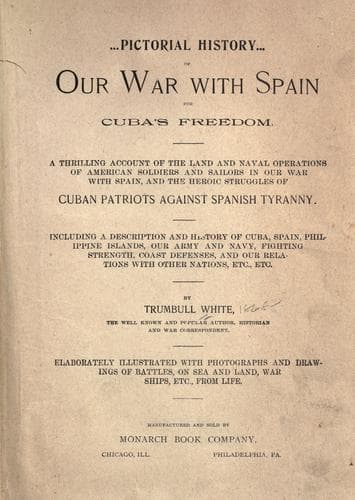
Our War with Spain for Cuba's FreedomWhite, Trumbull
History
Our War with Spain for Cuba's Freedom
White, Trumbull
Cuba -- History; Spain -- Foreign relations -- United States; Spanish-American War, 1898; United States -- Foreign relations -- Spain
But the cargo was not landed, for the reason that the insurgents
were unable to meet the landing party at the rendezvous, and
Captain Dorst was compelled to return to Key West with his cargo.
The second attempt was more successful. Nearly 400 men, with a
pack train and a large quantity of arms and ammunition, sailed on
the Plant line steamer Florida from Key West, on the night of May
21. These men and the equipment constituted an expedition able to
operate independently and to defend itself against any body of
Spanish troops which might oppose it.
The expedition was under the command of Captain Jose Lacret,
formerly insurgent commander in Matanzas province. He assumed the
direction of affairs immediately on the landing of the expedition.
Until then General Joaquin Castillo was in control.
In the landing of the expedition the United States army was
represented by Captain J. A. Dorst, and Tomas Estrada Palma was
represented by J. E. Cartaya, who has been the landing agent of
nearly every filibustering expedition for more than a year.
Messrs. Castillo, Cartaya and Dorst returned to Key West. General
Julio Sanguilly, on his way to report to General Maximo Gomez, was
also on the boat.
MOST POWERFUL OF THEM ALL.
This was the most powerful anti-Spanish expedition sent to Cuba up
to that date. About 300 of the men were Cubans, the others
Americans. The engineer corps of the expedition was composed
entirely of Americans under Aurelian Ladd.
The men were dressed in canvas uniforms furnished by the United
States government, and the commissary department had rations
enough to last fifteen days after the landing. The pack train
consisted of seventy-five mules and twenty-five horses. The
expedition carried 7,000 rifles and 3,000,000 rounds of ammunition
for General Calixto Garcia.
GENERAL SANGUILLY'S RETURN.
General Sanguilly's return to Cuba is a remarkable incident in his
extraordinary career. His gallant services in the Ten Years' War,
his arrest in Havana at the beginning of the present insurrection,
his sentence to death and his release at the intercession of
Secretary Sherman on a promise to remain outside of Cuba have made
him a conspicuous man.
The expedition was convoyed by the cruiser Marblehead, the
torpedo-boat destroyer Eagle and other warships. Two younger
brothers of the late General Nestor Aranguren are with the
expedition.
SOME OF LACRET'S ADVENTURES.
When the present revolution in Cuba began General Jose Lacret
Morlot, by which title he is popularly known, secured passage on
the steamer Mascotte for Jamaica on his way to Cuba. The English
government had information regarding Lacret's movements and
prevented his sailing for Cuba from Jamaica. He then went to
Mexico and later to New York. At the latter place he consulted
with the junta and returned to Tampa. Here he embarked on the
steamer Olivette for Havana in the garb of a priest.
Public-domain text, read in full here on John Shaqi.
Reviews
Reviews
No reviews yet
Be the first to share your thoughts on this work.
Elsewhere in the archive
Join the Discussion
Join the discussion
Sign in to leave a comment or review.
Sign InorCreate an account