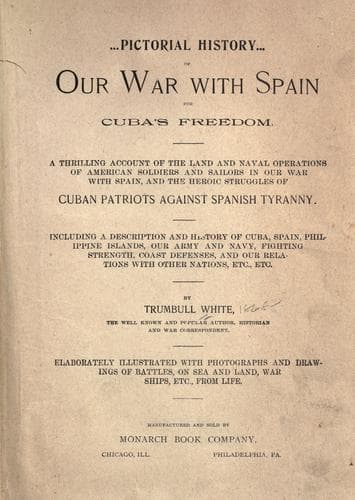
Our War with Spain for Cuba's FreedomWhite, Trumbull
History
Our War with Spain for Cuba's Freedom
White, Trumbull
Cuba -- History; Spain -- Foreign relations -- United States; Spanish-American War, 1898; United States -- Foreign relations -- Spain
It was the intention of the insurgents to begin operations in the
six provinces on the same date, but at the appointed time three of
them failed to carry out the plan, and in only one was the aspect
at all threatening. In Havana and Matanzas the Spanish officials
had no difficulty in suppressing the insurrectionists, and the
leader in the former province, the editor of a newspaper, accepted
a pardon and returned to his work.
In Santiago, however, which is thinly settled, the movement gained
ground steadily. The landing of a party of revolutionists from San
Domingo aroused the patriots, and were welcomed warmly, being
supplied with re-enforcements wherever they appeared. The
government professed to be merely annoyed, nothing more, and
pretended to look upon the patriots as mere brigands. Calleja
became alarmed at last when the determination of the insurgents
became known, and proclaimed martial law in Santiago and Matanzas,
and sent forces to both provinces. He could put only nine thousand
men in the field, however, and had only seven gunboats for coast
duty at his command. The commissary arrangements were miserable,
and frequently caused the interruption of important movements. The
insurgents were most ubiquitous, and would appear here and there
without the slightest warning, making raids on plantations, which
they plundered, and from which they enticed away the laborers,
disappearing in the swamps, where pursuit was impossible, and
appearing again in a day or so in some unexpected spot, and
repeating the same maneuvers. In this manner they terrorized the
loyalists, and ruined their prospects of raising a crop, and as
many depended solely upon the soil for their living this method of
warfare struck them a vital blow.
At the end of March, 1895, Antonio Maceo, with sixteen comrades,
sailed from Costa Rica and landed at Baracoa, on the eastern end
of the island. They were surprised by a Spanish cavalry, but kept
up an intermittent fight for several hours, when Maceo managed to
elude his enemies and escape. After living in the woods for ten
days, making his way westward, he met a party of rebels, was
recognized and welcomed with great enthusiasm. He took command of
the insurgents in the neighborhood and began to get recruits
rapidly. He engaged in several sharp encounters with the Spanish
and did such effective service that the moral effect was noticed
immediately. He and his brother Jose were made generals.
About the middle of April Maximo Gomez and Jose Marti landed from
San Domingo at about the same point where the Maceos had landed.
For days they were obliged to secrete themselves in a cave on
account of the presence of the enemy's pickets, but they finally
reached an insurgent camp, and Gomez entered upon his duties as
commander-in-chief. The insurgents now had an experienced leader
at their head, re-enforcements poured in, and they soon had a
force of six thousand men.
ARRIVAL OF CAMPOS.
Public-domain text, read in full here on John Shaqi.
Reviews
Reviews
No reviews yet
Be the first to share your thoughts on this work.
Elsewhere in the archive
Join the Discussion
Join the discussion
Sign in to leave a comment or review.
Sign InorCreate an account