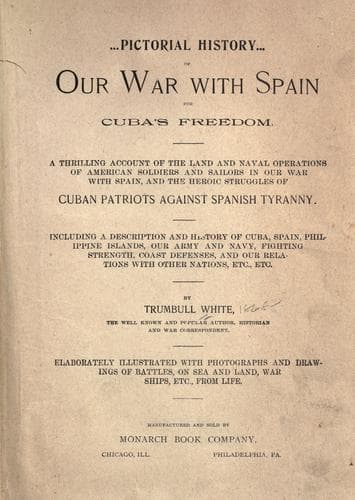
Our War with Spain for Cuba's FreedomWhite, Trumbull
History
Our War with Spain for Cuba's Freedom
White, Trumbull
Cuba -- History; Spain -- Foreign relations -- United States; Spanish-American War, 1898; United States -- Foreign relations -- Spain
The government had issued new calls for troops, and in April no
less than twenty-five thousand men were raised. Martinez Campos
came over from Spain, arriving at Santiago on April 16, and went
at once to Havana, where he relieved Calleja as captain-general.
Campos was a veteran, and expected to crush the insurrection at
once, but day by day his task grew more difficult.
Gomez and Maceo, instead of being driven hither and thither, led
Campos a dance, and he was prevented from solidifying the two
trochas he had formed. Gomez never attempted pitched battles or
sieges, but harassed the enemy in every way possible, cutting off
their convoys, picking them off in detail, getting up night
alarms, and in every way annoying them. His hardened soldiers,
especially the negroes, could stand hardships and still keep in
good fighting condition, but with the Europeans, what between
yellow fever and the constant alarms of war, it was a different
story. No European soldier could live under the hardships and
exposures which seemed to put life into the negro soldiers.
NO CASTE PREJUDICES.
It must be understood that there is no caste feeling between the
negro and the pure-blooded Cuban. They march, eat and sleep side
by side. Moreover, the negroes make excellent soldiers, with finer
physique than the Cubans themselves, and equal powers of
endurance.
The Cuban is small in stature compared to the American soldier,
but he is well set up, wiry, and apparently has unlimited staying
powers. He frequently lives on one meal a day, and that a poor
one, but he shows no signs whatever of being ill-fed; in fact, he
seems to thrive on it, and he has an uncomfortable habit of
marching six hours in the morning on an empty stomach, which would
be fatal to the ordinary Anglo-Saxon.
About the first of July, Maceo, still in the province of Santiago,
concentrated the forces in the Holguin district and moved against
Bayamo, capturing one provision train after another that were en
route to that place. Campos took fifteen hundred men, with General
Santocildes second in command, and went to the relief of Bayamo.
About the middle of July he was attacked several miles from Bayamo
by Maceo with twenty-seven hundred rebels. He and his entire staff
narrowly escaped capture, and only the bravery of General
Santocildes averted this catastrophe. The brave general lost his
life and the Spaniards were forced to fly, after having fought for
five hours, surrounded on all sides by the rebels. They finally
made their escape to Bayamo, the rear guard covering their retreat
with great difficulty.
Public-domain text, read in full here on John Shaqi.
Reviews
Reviews
No reviews yet
Be the first to share your thoughts on this work.
Elsewhere in the archive
Join the Discussion
Join the discussion
Sign in to leave a comment or review.
Sign InorCreate an account