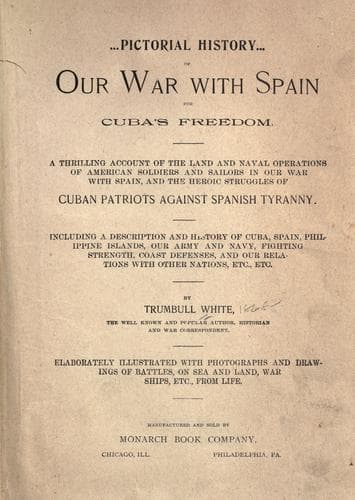
Our War with Spain for Cuba's FreedomWhite, Trumbull
History
Our War with Spain for Cuba's Freedom
White, Trumbull
Cuba -- History; Spain -- Foreign relations -- United States; Spanish-American War, 1898; United States -- Foreign relations -- Spain
Suddenly, to their astonishment, Quintin Bandera's infantry arose
on either side of the road and almost annihilated the pursuing
column. Those who escaped alarmed the columns of infantry, who
returned to San Luis to fortify themselves. Maceo and Bandera
camped on the estate of Mejorana, about six miles away. It was
here that Marti, Gomez, the two Maceos, Crombet, Guerra, and Rabi
met not long before this to inaugurate the new revolution. Bandera
and Maceo found plenty of provisions at the estate, but no bread.
A small Cuban boy was sent to the Spanish commander at San Luis
with a note requesting him to be so kind as to send some bread to
visitors at the Mejorana plantation. The boy delivered the note
and the Spanish commander asked who sent him. Without a moment's
hesitation he replied: "General Maceo." The Spanish official
laughed and replied: "Very well, a supply of bread will be sent.
It will not be necessary for Maceo to come after it." What is more
remarkable is the fact that Maceo told the correspondent
beforehand that the bread would be sent, as the Spaniards had been
so frightened by Bandera on the previous day that they did not
want to invite another attack. That very evening the boy returned,
conveying many bags of bread. The Spaniards remained within the
town until Maceo had rested his army and departed for Jarahuica.
CAMPOS' CAMPAIGN FAILS.
Before the end of the year Campos' campaign was admitted to be a
failure. He could not depart from his humane policy, however, and
at the beginning of the year 1896 he returned to Spain. The rabid
Spaniards of Havana, having compelled Campos to tender his
resignation, demanded from Canovas a captain-general framed in the
old iron cast of the Spanish conquerors, not to fight battles and
risk his life in the field, but to exterminate the native
population. In their belief, women, children, everyone born in
Cuba, should be held responsible for the situation. They did not
like a soldier with a gallant career and personal courage. They
wanted an executioner. Canovas satisfied them and appointed Don
Valeriano Weyler y Nicolau to succeed Martinez Campos.
The question may be asked why the insurgents after so many
victories did not invest the city of Havana, and end therewith the
Spanish dominion. The answer is very clear. After the battle of
Coliseo General Gomez reviewed his troops and found that each
soldier had only three cartridges. The Cubans in the United States
were making vain efforts to send a big expedition to the
insurgents, but the policy of our government was non-interference,
and they were checked in their plans. At Guira de Helena, on
January 4, 1896, the Cubans had to fight with their machetes to
enter the Province of Havana.
Public-domain text, read in full here on John Shaqi.
Reviews
Reviews
No reviews yet
Be the first to share your thoughts on this work.
Elsewhere in the archive
Join the Discussion
Join the discussion
Sign in to leave a comment or review.
Sign InorCreate an account