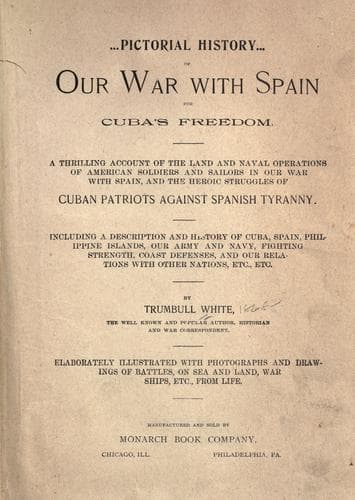
Our War with Spain for Cuba's FreedomWhite, Trumbull
History
Our War with Spain for Cuba's Freedom
White, Trumbull
Cuba -- History; Spain -- Foreign relations -- United States; Spanish-American War, 1898; United States -- Foreign relations -- Spain
If history does not afford a parallel of the stern resolution
displayed by the Cubans to die or to win in a struggle with all
the odds against them, neither does it present a case of stubborn
resistance to justice and human rights, and of barbarous cruelty,
which equals the record of Spain in Cuba.
CHAPTER XX.
JOSE MARTI AND OTHER CUBAN HEROES.
A Cuban Patriot--A Life Devoted to the Cause--First Work for
Cuba--Banished From His Native Land--He Returns to Fight for
Freedom--His Death--Maximo Gomez, General-in-Chief of the Cuban
Forces--His Methods of Warfare--Antonio Maceo, the Colored
Commander--Other Military Men of Note in the Cuban Army.
When the day comes that Cuba shall take her place among the free
and independent nations of the earth, Jose Marti, who probably did
more than any other one man to arouse the insurgents to make the
final struggle for liberty, will not be among them to share their
triumphs. Struck down, by a Spanish bullet, almost at the
commencement of the last revolution, he sleeps beneath the,
southern skies, and neither the clash of swords nor the thunder of
the cannon over his grave can disturb his rest.
Born in Havana, the son of a Spanish army officer, he was taught
from his childhood days that the friends of Cuba's cause were
rebels, deserving of death. But as he grew older he commenced to
think for himself, and the more he learned of Spanish robbery,
injustice and cruelty, the more determined he became to devote his
life to the cause of his native land.
While yet a mere boy, he began the work. He published clandestine
circulars, he wrote a play in which he depicted the wrongs
inflicted upon the island people; "Free Cuba" was his thought by
day, his dream at night. Through imprisonment and exile, in Spain,
Mexico and the United States, every action of his life was guided
by the one ambition.
On April 14th, 1895, in company with Maximo Gomez, Marti landed on
the coast of Cuba, at Cobonico. His coming gave the insurgents new
courage, and their numbers increased rapidly. He was made a Major
General of the army, and in company with Gomez, who had seen
service in the previous campaign, he led a number of successful
attacks against detachments of the Spanish forces.
After organizing an expedition that was to march to Puerto
Principe under Gomez's command, Marti intended to go to the
seacoast in order to return abroad and continue his work there in
favor of the secessionist revolution.
About this time a man named Chacon was captured by Colonel
Sandoval, of the Spanish forces, and letters from the rebels were
found in his possession, and some money with which he was going to
make purchases for the insurgent chiefs. This man gave information
regarding the enemy's location, and acting upon this knowledge,
Colonel Sandoval, on the 19th of May, brought his army to La
Brija. The Hernan Cortez squadron, under Captain Capa, was in
vanguard, and attacked a band commanded by Bellito, which had come
to meet the column.
Public-domain text, read in full here on John Shaqi.
Reviews
Reviews
No reviews yet
Be the first to share your thoughts on this work.
Elsewhere in the archive
Join the Discussion
Join the discussion
Sign in to leave a comment or review.
Sign InorCreate an account