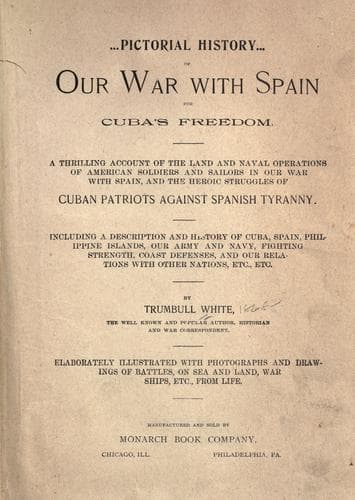
Our War with Spain for Cuba's FreedomWhite, Trumbull
History
Our War with Spain for Cuba's Freedom
White, Trumbull
Cuba -- History; Spain -- Foreign relations -- United States; Spanish-American War, 1898; United States -- Foreign relations -- Spain
"General Gomez never has more than 300 or 400 men with him. His
favorite camp is near Arroyo Blanco, on a high plateau, difficult
to approach, and covered with dense thicket. He posts his outer
pickets at least three miles away, in directions from which the
enemy may come. The Spaniards, whenever possible, march by road,
and, with these highways well guarded, Gomez sleeps secure. He
knows that his pickets will be informed by some Cuban long before
the Spanish column leaves or passes the nearest village to attack
him. A shot from the farthest sentry causes little or no
excitement in Gomez's camp. The report throws the Spanish column
into fears of attack or ambush, and it moves forward very slowly
and carefully. Two pickets at such a time have been known to hold
2,000 men at bay for a whole day. If the column presses on, and
General Gomez hears a shot from a sentinel near by, he will rise
leisurely from his hammock and give orders to prepare to move
camp. He has had so many experiences of this kind that not until
he hears the volley-shooting of the oncoming Spaniards will he
call for his horse, give the word to march, and disappear,
followed by his entire force, into the tropical underbrush, which
closes like curtain behind him, leaving the Spaniards to discover
a deserted camp, without the slightest trace of the path taken by
its recent occupants.
"Sometimes Gomez will move only a mile or two. The Spaniards do
not usually give chase. If they do, Gomez takes a keen delight in
leading them in a circle. If he can throw them off by nightfall,
he goes to sleep in his camp of the morning, happier than if he
had won a battle. The Spaniards learn nothing through such
experiences. Gomez varies the game occasionally by marching
directly towards the rear of the foe, and there, reinforced by
other insurgent bands of the neighborhood, falling upon the column
and punishing it severely. While his immediate force is but a
handful, the General can call to his aid, in a short time, nearly
6,000 men."
A COLORED COMMANDER.
As soon as the rebellion had assumed such proportions as to make
it possible to arrange a regular military organization among the
insurgents, Antonio Maceo was made the second in command, under
General Gomez, with the title of Lieutenant General. He had risen
from the ranks to the position of Major General in the Ten Years'
war, where, notwithstanding his colored blood, he had shown
unusual ability as a leader of men. Sons of the first families of
Cuba were proud to enlist under his banner, and to recognize him
as their superior officer. Space is devoted in another part of
this volume to an account of the treacherous manner of his death.
The following letter, written by him to General Weyler, soon after
the arrival of the latter named in Cuba, shows that he could fight
with his pen as well as with his sword:
Republic of Cuba, Invading Army. Second Corps, Cayajabos, Feb. 27,
1896.
General Valeriano Weyler, Havana:
Public-domain text, read in full here on John Shaqi.
Reviews
Reviews
No reviews yet
Be the first to share your thoughts on this work.
Elsewhere in the archive
Join the Discussion
Join the discussion
Sign in to leave a comment or review.
Sign InorCreate an account