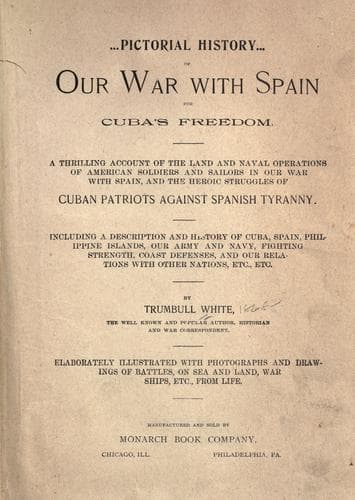
Our War with Spain for Cuba's FreedomWhite, Trumbull
History
Our War with Spain for Cuba's Freedom
White, Trumbull
Cuba -- History; Spain -- Foreign relations -- United States; Spanish-American War, 1898; United States -- Foreign relations -- Spain
When Colonel Sandoval heard of it, he advanced up to the plain of
Dos Rios, and ordered his infantry to open fire. A spirited combat
ensued, with fatal results to the insurgents, as the Spanish
guide, Antonio Oliva, running up to help a soldier who was
surrounded by a large group of the enemy, fired his rifle at a
horseman, who fell to the ground, and was found to be Jose Marti.
Captain Enrique Satue was the first to recognize him. A fight took
place upon the spot, the rebels trying hard to carry the corpse
away, but they were repulsed. Maximo Gomez was wounded in the
encounter, which for some days led to the belief that he too was
dead. According to one narrative, Gomez was in the midst of the
battle from the beginning, and while hurrying to recover the
corpse of Marti, he was slightly wounded. Others say that the
famous chief, had already taken leave of Marti to go to Camaguey,
when, passing at some distance from Dos Rios, he heard the report
of musketry. He imagined what was happening, and ran to rescue the
civil chief of the revolution, but when he arrived, Marti had been
killed. Gomez being wounded, Borrero took him on his own horse,
and in this manner carried him to a place of safety. The
Spaniards, after their victory, moved to Remanganagaus, where the
corpse of Marti was embalmed. From the latter town it was taken to
Santiago de Cuba, and while on the way there, the troops had to
repel an attack from the rebels, who intended to carry off the
coffin. On arriving at the city, the remains of Marti were
exhibited at the cemetery. Colonel Sandoval presided over the
funeral ceremonies, and the dead leader was given a decent resting
place. Here are Sandoval's words on the occasion:
Gentlemen:--In presence of the corpse of him who in life was Jose
Marti, and in the absence of any relative or friend who might
speak over his remains such words as are customary, I request you
not to consider these remains to be those of an enemy any more,
but simply those of a man, carried by political discords to face
Spanish soldiers. From the moment the spirits have freed
themselves of matter they are sheltered and magnanimously pardoned
by the Almighty, and the abandoned matter is left in our care, for
us to dispel all rancorous feelings, and give the corpse such
Christian burial as is due to the dead.
MAXIMO GOMEZ, THE GENERAL-IN-CHIEF.
The General-in-Chief of the Cuban forces is Maximo Gomez, a man of
scholarly attainments, great intellect, and long experience in
military affairs. Formerly an officer of Spain, he explains his
present position in the following words:
"When I gave up, in 1868, my uniform and rank as a Major of the
Spanish Army, it was because I knew that if I kept them. I would
have some day to meet my own children in the field, and combat
against their just desire for liberty. Now, with my many years, I
have come to lead and counsel the new generation to ultimate
victory."
Of his methods in war, Thomas Alvord says:
Public-domain text, read in full here on John Shaqi.
Reviews
Reviews
No reviews yet
Be the first to share your thoughts on this work.
Elsewhere in the archive
Join the Discussion
Join the discussion
Sign in to leave a comment or review.
Sign InorCreate an account