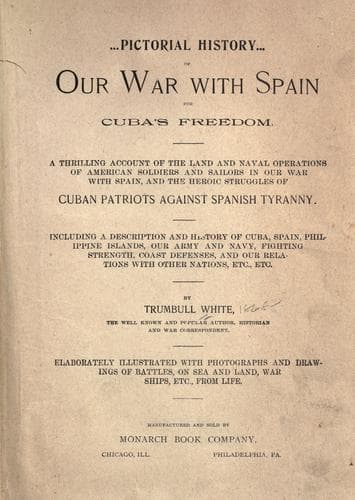
Our War with Spain for Cuba's FreedomWhite, Trumbull
History
Our War with Spain for Cuba's Freedom
White, Trumbull
Cuba -- History; Spain -- Foreign relations -- United States; Spanish-American War, 1898; United States -- Foreign relations -- Spain
There is a story told of a great Roman General who, after having
conquered in many battles, beat his sword into a plowshare, and
turned from war's alarms to the peaceful pursuit of agriculture.
The Cuban has reversed the story. When he left his labors in the
forests and fields to fight his oppressors, he carried with him
the implement with which he had cut the sugar cane on his
plantation, and made paths through dense tropic vegetation. The
machete is the sword of the Cuban soldier, and it will be famous
forever. Its blade is of tempered steel, curved slightly at the
end, with one edge sharp as a razor. It has a handle of horn, and
is carried in a leather scabbard, attached to a narrow belt.
The weapon in the hands of one who understands its use is terribly
effective. Instances have been known where rifle barrels have been
cut in two by it, and heads have been severed from their bodies at
a single stroke. Its name, shrieked in a wild ferocious way, is
the battle cry of the insurgents, and when shouted from an hundred
throats, it carries with it so awe-inspiring a sound, that it is
little wonder that the enemy is stricken with fear, for it means
in reality "war to the knife."
CAVALRY CHARGES.
The Cubans are among the most skillful and daring rough riders of
the world, the equals of the cowboys of our western States, and
the far-famed Cossacks of Russia. The horses' backs have been
their cradles, and here they possess a decided advantage over
their Spanish foes, who know as little of the equestrian art as
they seem to understand of other's rights, or the amenities of
war. A mounted band of insurgents, rushing down on a detachment of
the enemy, waving aloft the terrible machete, will carry with them
terror and death, and conquer twice their number.
The heroic mulatto brothers, Antonio and Jose Maceo, adopted this
manner of fighting on every possible occasion, and it is a
coincidence worthy of note that they both met their death while
leading machete charges against their hated foes.
LACK OF AMMUNITION IN THE CUBAN RANKS.
The lack of ammunition is one of the weaknesses of the insurgents.
Courage, ability and men they possess in abundance, but the lack
of cartridges has interfered with many of their best laid plans,
and has often prevented them from availing themselves of favorable
opportunities. Three or four rounds a man is nothing in action,
especially when the Spaniards are always so abundantly supplied.
However they are determined, and as Spanish incapacity becomes
daily more apparent, they feel that it is only a question of a few
months until the cause for which they have so long and bravely
fought will be gloriously won.
MACEO AT THE FRONT.
Public-domain text, read in full here on John Shaqi.
Reviews
Reviews
No reviews yet
Be the first to share your thoughts on this work.
Elsewhere in the archive
Join the Discussion
Join the discussion
Sign in to leave a comment or review.
Sign InorCreate an account