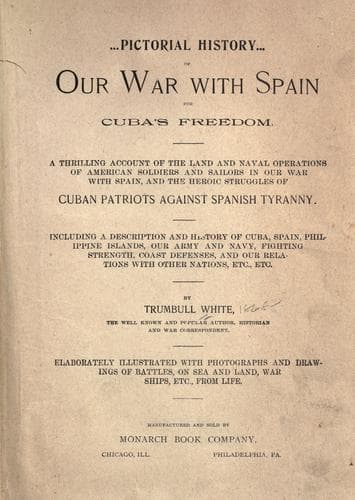
Our War with Spain for Cuba's FreedomWhite, Trumbull
History
Our War with Spain for Cuba's Freedom
White, Trumbull
Cuba -- History; Spain -- Foreign relations -- United States; Spanish-American War, 1898; United States -- Foreign relations -- Spain
Within three months of the time that Gomez and Maceo landed at
Baracoa they had all Santiago and Puerto Principe in a state of
insurrection. They started out with comparatively a handful of
men. The most reliable sources agree that there were not more than
300, but they were quickly joined by thousands of Cubans, who
brought out from hiding places arms and ammunition which they had
been collecting and concealing for years.
General Campos, the Spanish commander, had declared that Puerto
Principe would never rise against Spain, and he proposed at once a
plan to make it doubly sure. He procured special concessions from
Madrid for the foreign railroads, permitting them to import iron
bridges to replace their wooden structures, and pledging them
$20,000 a month until they had extended their lines and made
connections to complete a continuous road through the country,
using the money to employ the natives. This was to insure the
peace of Puerto Principe and Santa Clara, both considered
conservative, and to prevent the people joining the revolutionary
party.
After the plan was announced, the revolutionists burned out the
wooden bridges, tore up the tracks in many places, and the roads
have been, for all practical purposes, in their hands ever since.
Campos, meantime, to prevent Gomez moving eastward, placed 10,000
troops on the border between the provinces of Puerto Principe and
Santiago, but Gomez crossed the line on May 19th, after a battle
at Boca del Dos Bios, where a loss was suffered in the death of
General Marti, which was so great a blow to Cuba that Campos
announced that the "death blow to the bandits had been struck."
In Puerto Principe Gomez captured every town he attempted to take,
among them Alta Gracia, San Jeronimo and Coscorro. He took Fort El
Mulato, and in all the places secured large quantities of
ammunition. So enthusiastic was his reception in the provinces of
Puerto Principe and Santa Clara that in the latter 400 Spanish
volunteers joined him with their arms.
The most important battle of the summer occurred at Bayamo in
July, just as Gomez was near the Spanish line between Santa Clara
and Puerto Principe, where, in an engagement between the two
armies, with about 3,000 men on either side, the Spanish forces
were completely routed.
From that time on through the summer and far into the autumn,
every day was marked by skirmishes, the taking of important
places, and the threatening of the larger towns. It kept the
Spanish columns moving constantly, and the exposure in the rainy
season killed thousands.
Maceo now separated his forces from Gomez's command, and marched
westward, fighting as he went, and everywhere meeting with
success. He established the new government in the cities and towns
of Mantua, San Cristobal, Remates, Palacios, Paso Real de San
Diego, Guane, Consolacion del Sur, Pilotos, Alonso de Rojas, San
Luis, San Juan y Martinez, and others of less importance.
Public-domain text, read in full here on John Shaqi.
Reviews
Reviews
No reviews yet
Be the first to share your thoughts on this work.
Elsewhere in the archive
Join the Discussion
Join the discussion
Sign in to leave a comment or review.
Sign InorCreate an account