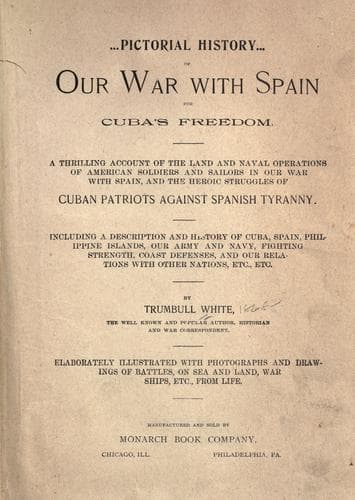
Our War with Spain for Cuba's FreedomWhite, Trumbull
History
Our War with Spain for Cuba's Freedom
White, Trumbull
Cuba -- History; Spain -- Foreign relations -- United States; Spanish-American War, 1898; United States -- Foreign relations -- Spain
Pinar del Rio City, the capital of the province, was the only city
of importance that held out, but it was cut off with communication
with its port, Colon, and was short of provisions. One supply sent
by the Spanish for its relief, 100,000 rations, fell into Maceo's
hands.
In San Cristobal the Spanish flag on the government building was
replaced by the emblem of the new republic, a mayor and city
officials were appointed, resolutions were adopted by the new
authorities, and, after all the arms in the town had been
collected, Maco remained a day to rest his men and horses, and
moved on the following morning at daybreak.
Generals Navarre and Luque were ordered to crush the insurgent army at
all hazards. Their combined forces consisted of 5,000 infantry, 200
cavalry, and 11 pieces of artillery. After a two-days' march they were
joined by General Arizon's command, which had encountered Maceo's rear
guard the previous day, with disastrous results.
Near Quivera Hacha, Navarre's skirmishers encountered a small band
of insurgents, and fearing that all of Maceo's army was near,
lines of battle were quickly formed. The engagement lasted for
less than half an hour, when the insurgent forces withdrew,
without serious losses on either side. General Navarro finally
discovered that the principal part of Maceo's forces was at the
Armendores estate, and the seat of operations was changed. General
Luque succeeded Navarro in command, and several days now passed
without any conflict of note. Finally Luque led a charge upon
Maceo's vanguard, in the vicinity of Pinar del Rio, but the moment
the attack was made he found himself under fire from the top of
low hills on both sides of the road, where the insurgents were
well protected, and he sustained severe losses without inflicting
much injury upon the enemy. So hot was the encounter that Luque
withdrew and prepared to charge upon two points where the enemy
were making a stand. He held the road with one battalion, sending
a detachment to the right, and another to the left. The attack was
successful. The Spanish made a magnificent effort under withering
fire, and swept Maceo's forces before them, not, however, until
they had left the field scattered with their own dead and wounded.
For some reason the cavalry had not been used. The artillery was
just coming up when the action had reached this point. The Spanish
found that the enemy had, instead of being routed, simply fallen
back and taken a position on another hill, and scattered firing
went on for a considerable time, while Luque prepared to attack
again. Then, against 2,000 of Maceo's men, was directed all of
Luque's command, over 4,000 infantry, 200 cavalry, and eleven
pieces of artillery.
At least half of Maceo's army, certainly not less than 2,000
cavalry, had been moving up to Luque's rear and came upon him,
surprising him just as this second attack was being made.
Public-domain text, read in full here on John Shaqi.
Reviews
Reviews
No reviews yet
Be the first to share your thoughts on this work.
Elsewhere in the archive
Join the Discussion
Join the discussion
Sign in to leave a comment or review.
Sign InorCreate an account