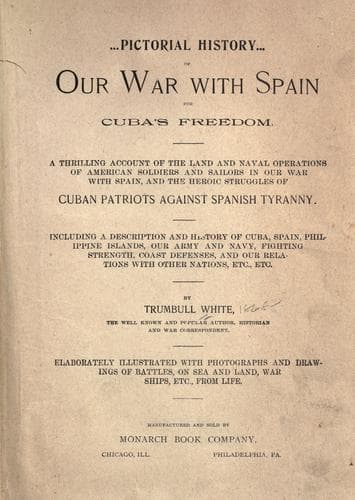
Our War with Spain for Cuba's FreedomWhite, Trumbull
History
Our War with Spain for Cuba's Freedom
White, Trumbull
Cuba -- History; Spain -- Foreign relations -- United States; Spanish-American War, 1898; United States -- Foreign relations -- Spain
The "Conspiracy of Lopez," which is fully treated of in previous
pages of this work, was the first filibustering expedition that
attracted particular attention from the authorities, and it was
hoped that its disastrous end would deter others from like
attempts. But the hope was a vain one, for within two years a
similar expedition, led by General Quitman of Mississippi, was
organized in the United States. Many men were enlisted and vessels
chartered, but the expedition was suppressed by the government of
the United States.
EXPENSE TO UNITED STATES.
It will thus be seen that the fact that Spain had not been able to
govern Cuba peaceably has caused the United States great expense
and irritation for a much longer period than is usually taken into
consideration in these days. It is not the fault of the United
States that its citizens have been stirred to sympathy with the
victims of the Spanish policy of government by robbery and murder.
It is not the fault of the United States that this country has
been the refuge of men who have been outlawed from the country of
their birth because their presence there meant the irrepressible
working in them of a desire for freedom, a desire intolerable to
Spanish institutions.
It is not the fault of the United States that these refugees,
living in the land of civil liberty, should desire to return to
their native country and drive out those who made it miserable.
But it would have been the fault of the United States, under
international law, if these exiled Cubans were permitted to carry
out their very natural and laudable desire in concert with the
Americans whose sympathy had been stirred by the story of Spanish
wrongs. To ferret out the plans for expeditions conceived with
such determination and perseverance was not only a task requiring
tremendous expenditure of money and energy, but it was a miserably
disagreeable and unpopular work for the government to engage in.
On the 31st of May, 1854, President Pierce issued a proclamation
instructing citizens of the United States as to their duties in
refraining from encouragement, aid, or participation in connection
with the Cuban insurrections.
THE UPRISING IN 1868.
In the fall of 1868, after scattering uprisings and several
battles during the preceding year, plans for a concerted
insurrection were arranged. The plan was discovered and the
insurrection was started prematurely. There followed a campaign in
which Spanish forces, amounting to 110,000 men, were unable to
hold in check the Cuban force of about 26,000. In May the
filibustering expeditions, that were to prove such an immense
expense and annoyance to the United States, began again. The
Spanish navy co-operated with the United States government in the
efforts to suppress these expeditions, but many of them eluded the
authorities, and aided the insurgents with arms and provisions.
Public-domain text, read in full here on John Shaqi.
Reviews
Reviews
No reviews yet
Be the first to share your thoughts on this work.
Elsewhere in the archive
Join the Discussion
Join the discussion
Sign in to leave a comment or review.
Sign InorCreate an account