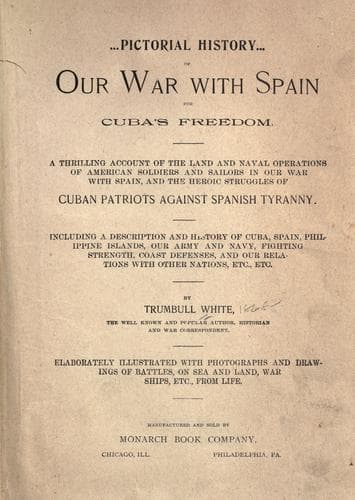
Our War with Spain for Cuba's FreedomWhite, Trumbull
History
Our War with Spain for Cuba's Freedom
White, Trumbull
Cuba -- History; Spain -- Foreign relations -- United States; Spanish-American War, 1898; United States -- Foreign relations -- Spain
This was irritating to Spain and the United States alike, because
it cost just as much to keep up an unsuccessful anti-filibustering
patrol as it did actually to catch filibusters, and, moreover,
every successful expedition weakened the authority of the Federal
government. That authority in the Southern States just after the
war was none too strong, and it was not a good thing that the
spectacle of defiance to the United States should be flaunted
along the Southern coast.
From 1878 until 1895, when the present insurrection gained
strength to become openly active, the island is supposed to have
been at peace, but in the latter year the open war and
filibustering expeditions began again. The name of President
Cleveland was added to the list of Presidents whose duty it was to
interfere with efforts to aid Cuban liberty. He issued appropriate
proclamations on June 12, 1895, and July 30, 1896. Revenue cutters
and warships constantly patrolled the Florida coast and, indeed,
all the waters of the gulf, and sometimes New York harbor, to head
off filibustering expeditions. It is said to have cost more to
suppress the natural desire of citizens of the United States to
relieve the political distress in Cuba than it has cost to enforce
customs regulations from the same territory.
THE VOYAGE OF THE "THREE FRIENDS."
As evidence of the fact that Cuban sympathizers have been
successful in escaping the patrol on American coasts and the
enemy's battleships in Cuban waters, we give the report of one of
many expeditions that have been made during the past three years.
The steamer "Three Friends," of Jacksonville, Florida, in command of
Captain Napoleon B. Broward, returned to Jacksonville on March 18th,
having succeeded in landing in Cuba, General Enrique Collazo, Major
Charles Hernandez, and Duke Estrada, besides fifty-four men taken off
the schooner "Ardell" from Tampa, and the entire cargo of arms and
ammunition of the schooner "Mallory" from Cedar Key. It was by long odds
the most important expedition that has set out from this country, and
the Cubans at Jacksonville, when they learned that the "Three Friends"
had safely fulfilled her mission, shouted "Viva Cuba!" until they were
hoarse.
They declared that it would change the character of the whole war,
as the unarmed men would now be armed, and that Maceo, who had
before been wary and cautious, would be more aggressive than he
had ever been before. The cargo of arms landed by the "Three
Friends" and the "Mallory" was as follows: 750,000 rounds of
cartridges, 1,200 rifles, 2,100 machetes, 400 revolvers, besides
stores, reloading tools, etc.
Public-domain text, read in full here on John Shaqi.
Reviews
Reviews
No reviews yet
Be the first to share your thoughts on this work.
Elsewhere in the archive
Join the Discussion
Join the discussion
Sign in to leave a comment or review.
Sign InorCreate an account