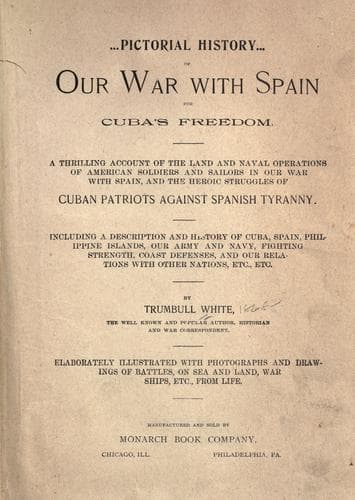
Our War with Spain for Cuba's FreedomWhite, Trumbull
History
Our War with Spain for Cuba's Freedom
White, Trumbull
Cuba -- History; Spain -- Foreign relations -- United States; Spanish-American War, 1898; United States -- Foreign relations -- Spain
The "Three Friends" met the "Mallory" at Alligator Key. The
"Ardell" had just finished transferring the men to her. While they
were rendezvoused there behind the pines in a deep coral-walled
creek, three big Spanish men-of-war steamed slowly by, but they
did not discover that there was anything suspicious looking in
shore, although with a glass men could be seen in their look-outs
scanning the horizon, as well as searching the shore. Sunday,
about noon, no vessels being in sight, the "Three Friends" took in
tow the "Mallory" and steamed southward under a good head of
steam.
The "Three Friends" is a powerful tug, and by Monday night was
close enough to the Cuban shore to hear the breakers. Several
shiplights to the west were seen, one of which was evidently a
Spanish man-of-war, for she had a search-light at her bow, and was
sweeping the waves with it, but the "Three Friends" was a long way
off, and had no light, and so was out of the neighborhood of the
Spaniard.
A SUCCESSFUL LANDING.
At ten o'clock that night, by the aid of a naphtha launch and two
big surf boats, which had been taken out of Jacksonville, the
"Three Friends" landed the men and ammunition from her hold, and
from that of the "Mallory." It took four and a half hours to
complete the job. There were hundreds of men on shore to assist,
and they did it silently, appreciating the peril of the position.
The Cubans on shore recognized General Collazo immediately, and no
words can describe their joy on seeing him. He is a veteran of
Cuban wars, and one whom Spain fears. In fact, it is known that
during his sojourn in Florida he was shadowed by detectives, who
had been instructed to spare no expense to keep Collazo from
reaching Cuba. When it was whispered that Collazo was really among
them, they seemed not to believe their ears, but came forward and
looked, and, seeing that there was really no mistake, threw up
their arms and wept for joy. Major Charles Hernandez and Duke
Estrada were also enthusiastically welcomed.
It was reported that night that Maceo had received the arms of the
first expedition that set forth three days before the "Three
Friends" landed. They were not from the "Commodore," for they
reported that they were now on the lookout for that vessel. They
said, too, that at the end of the week four expeditions were
afloat. Two, including the "Three Friends," had landed, and two
more were on the way. Tuesday morning, as the "Three Friends" was
returning, she sighted a steamer that answered to the description
of the "Commodore." She was headed southward, and pushing along
apparently at the rate of fifteen knots an hour.
Here is the story of the capture of an expedition, by Commander
Butron, of the Spanish gunboat "Mensagera":
Public-domain text, read in full here on John Shaqi.
Reviews
Reviews
No reviews yet
Be the first to share your thoughts on this work.
Elsewhere in the archive
Join the Discussion
Join the discussion
Sign in to leave a comment or review.
Sign InorCreate an account