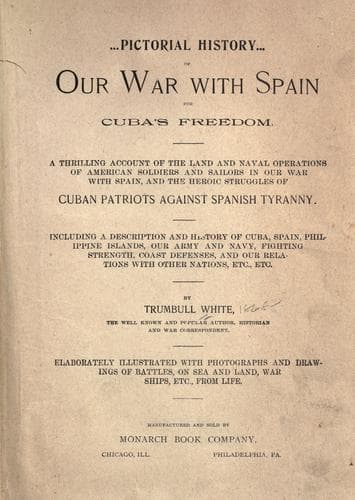
Our War with Spain for Cuba's FreedomWhite, Trumbull
History
Our War with Spain for Cuba's Freedom
White, Trumbull
Cuba -- History; Spain -- Foreign relations -- United States; Spanish-American War, 1898; United States -- Foreign relations -- Spain
"'With the progress of all nations the Cubans have progressed,' he
replied. 'There are many Cubans in sympathy with Spain, but this
insurrection is a blot upon the Cuban race which nothing can ever
erase. It is a stain made with the blood of the slain and the
tears of the women. It injures the Cubans themselves more than any
other.'"
In spite of Weyler's boasts when he assumed command of the Spanish
forces in Cuba that he would quickly put down the insurrection,
his failure was as complete as that of General Campos had been,
and his recall was finally demanded. In his letter of protest to
the home government he said:
"If the functions with which the government had entrusted me had
been merely those of Governor General of Cuba, I should have
hastened to resign. But the twofold character of my mission and my
duty as commander-in-chief in the face of the enemy prevent my
tendering a resignation.
"Nevertheless, although I can rely upon the absolute,
unconditional support of the autonomist and constitutional
parties, as well as upon public opinion, this would be
insufficient without the confidence of the government, now more
than ever necessary to me after the censure of which I have been
made the object by the members and journals of the Liberal party
and by public opinion in the United States, which latter is
largely influenced by the former. This confidence would be
necessary to enable me to put an end to the war, which has already
been virtually concluded from our lines at Jucaro to Cape
Antonio."
Senor Sagasta replied: "I thank you for your explanation and value
your frankness, I wish to assure you that the government
recognizes your services and values them as they deserve, but it
thinks a change of policy. In order to succeed, requires that the
authorities should be at one with the ministry."
CHAPTER XXIV.
CUBA UNDER THE SCOURGE.
The Civil Guards and Their Crimes--Horrible Murder of Eight
Innocent Men--A Man After Weyler's Own Heart--How the Spanish Gain
"Victories"--Life, Liberty and Property Sacrificed--The War Not a
Race War--Resistance to the Bitter End.
Cuba has been under martial law for over fifty years, and its
enforcement by the Civil guards (as the officers appointed by the
Spanish government are called) has been responsible for
innumerable outrages against the lives and property of the
inhabitants. These officials have been guilty of every crime in
the calendar, but protected by their positions they have escaped
legal punishment, and it has only been on occasions when, driven
to desperation, the people have acted as judges and executioners
by taking the law into their own hands that any redress has been
possible.
Public-domain text, read in full here on John Shaqi.
Reviews
Reviews
No reviews yet
Be the first to share your thoughts on this work.
Elsewhere in the archive
Join the Discussion
Join the discussion
Sign in to leave a comment or review.
Sign InorCreate an account