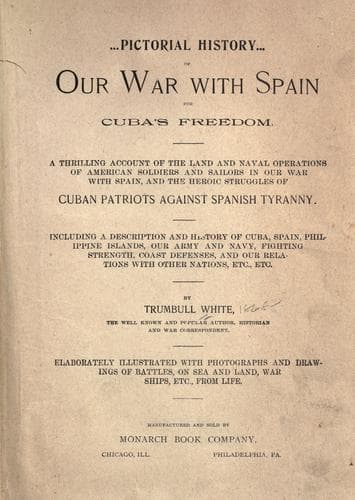
Our War with Spain for Cuba's FreedomWhite, Trumbull
History
Our War with Spain for Cuba's Freedom
White, Trumbull
Cuba -- History; Spain -- Foreign relations -- United States; Spanish-American War, 1898; United States -- Foreign relations -- Spain
"Two years ago yesterday, Julio Sanguilly, an American citizen,
was thrown into prison. Two years have gone by and this government
has done practically nothing for this citizen. Great Britain would
have released him as soon as one of her battleships could reach
Havana. He has been brutally treated and condemned on unsworn
testimony before military tribunals. This country and all
civilization have been disgraced by the treatment meted out to
this unfortunate man. Every citizen of this country would have
patriotically applauded the President if he had sent a fleet of
American battleships and compelled the release, of this American
citizen, whose country has been insulted by the treatment accorded
to him and to our representative in Cuba."
The Prime Minister at Madrid, realizing that trouble of a serious
nature was likely to come from this affair, cabled Weyler to
discharge the prisoner from custody, and banish him from the
island.
Sanguilly immediately came to the United States, where he was
warmly received by his friends, and he has since been actively
engaged in work for Cuba's freedom.
Charles Scott, an employe of the American Gas Company, was
arrested at Regla, charged with having Cuban postage stamps in his
possession. He was in solitary confinement, in a damp, empty cell,
five feet by eleven, for fourteen days. Once during his
imprisonment he was left for two days without even a drop of
water. General Lee, then United States Consul at Havana, cabled to
Washington, asking that arrangements be made to send war vessels
to Havana, in case of necessity, and declaring that unless his
requests were complied with, he would leave the island. In this
affair, as in many others, General Lee proved that he was the
right man in the right place, for it was due to his efforts in
Scott's behalf that he was finally given his liberty.
Mr. Charles Michaelson, a newspaper correspondent, and his
interpreter, were imprisoned, in Morro Castle as suspects. It
required fine detective work to discover this fact, for they were
missing for some time before it was definitely known that they
were in the clutches of Weyler, but the "Butcher" finally admitted
it, and after a short delay was persuaded by the United States
Consul to release them. Mr. Michaelson's treatment was almost
brutal in its nature.
Public-domain text, read in full here on John Shaqi.
Reviews
Reviews
No reviews yet
Be the first to share your thoughts on this work.
Elsewhere in the archive
Join the Discussion
Join the discussion
Sign in to leave a comment or review.
Sign InorCreate an account