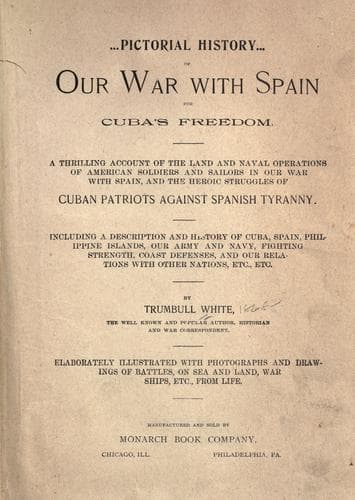
Our War with Spain for Cuba's FreedomWhite, Trumbull
History
Our War with Spain for Cuba's Freedom
White, Trumbull
Cuba -- History; Spain -- Foreign relations -- United States; Spanish-American War, 1898; United States -- Foreign relations -- Spain
The interior of the castle is like a dungeon, and he was compelled
to sleep on the floor, as a hammock sent to him by friends outside
was not given to him till the day of his release. His food was
thrown to him through the bars of the door, and meals sent in to
him were eaten by the guards. Rats were his constant companions,
and when, occasionally, he would sink into a light slumber, he
would be suddenly awakened to find one of the animals in his hair,
another burrowing under his coat, and still another making a meal
on his shoes. On one occasion he threw a shoe at a rat, which
struck the door of his cell, whereupon the guard threatened to
punish him for a breach of prison discipline, the noise being
against the rules.
Walter Dygart relates his experience while the enforced guest of
the Spanish government. It is evident that the keeper of a prison
in Cuba has a profitable occupation.
"A child may weep at brambles' smart,
And maidens when their lovers part;
But woe worth a country when
She sees the tears of bearded men."
"These lines by the poet, Scott, recurred to me when I saw aged
men weeping and heart-broken at being separated from their
families and shut up in this hell. But why does the Spanish
government shut up helpless cripples and non-combatants? This is a
question that puzzled me for some time, but I finally solved it,
and will answer it after I have described the food and water.
"A little after six in the morning we were, each of us, given a
very small cup of coffee. The first meal of the day, if it could
be called a meal, came after nine o'clock. It consisted of a
little rice, which was generally dirty, a few small potatoes,
boiled with their skins on, and often partly rotten, a little
piece of boiled salt beef, or beef cut up in small bits, with
soup, just about half enough, and of the poorest quality. The meat
was often spoiled and unfit for anything but a vulture to eat. The
second and last meal of the day came about four in the afternoon,
and was the same as the first.
"I had no opportunity to count the prisoners, but I learned that
there were about 180 on the average confined there. I learned as
definitely as I could, without seeing the contract, that a certain
party had the contract to feed these prisoners at twenty-five
cents each per day. Thus he gets $45 a day, and I learned that the
food costs him only $7 to $8 a day, and, as some of the prisoners
did the cooking, his profit can be readily seen. On such a
contract he could afford to divide with the judge and army
officers to keep the prison full."
A MINISTER OF THE GOSPEL IN MORRO CASTLE.
Public-domain text, read in full here on John Shaqi.
Reviews
Reviews
No reviews yet
Be the first to share your thoughts on this work.
Elsewhere in the archive
Join the Discussion
Join the discussion
Sign in to leave a comment or review.
Sign InorCreate an account