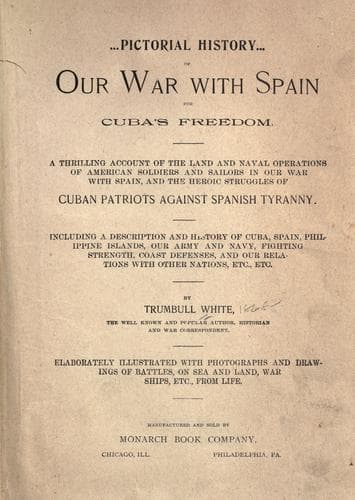
Our War with Spain for Cuba's FreedomWhite, Trumbull
History
Our War with Spain for Cuba's Freedom
White, Trumbull
Cuba -- History; Spain -- Foreign relations -- United States; Spanish-American War, 1898; United States -- Foreign relations -- Spain
The Southern Baptist Missionary Society has a mission in the city
of Havana, and it was formerly in charge of Rev. Alberto J. Diaz,
whose home is in the United States. Ever loyal to his flag, and
believing in the institutions of his country, he lost no
opportunity to preach civil as well as religious liberty, and
though often warned to desist, by the Spanish authorities, he
continued the course which he regarded as his solemn duty. He
gives particulars of his arrest as follows:
"About three o'clock one morning I was aroused by a knock at the
door of my house, and when I opened it I saw some fifty or sixty
Spanish soldiers, with their guns leveled at me. I quickly shut
the door and talked through it. The captain said he must search
the house, and I consented to let three men come in. They spent
seven hours looking through two trunks full of sermons, and other
papers, and when the search was completed they had found no
incriminating documents."
Nevertheless, both Dr. Diaz and his brother were imprisoned in
Morro Castle. They were tried for treasonable utterances and
sentenced to death. Fortunately one of the sentries of the prison
was a member of Dr. Diaz's church, and through his kind offices, a
message was sent to the president of the Southern Baptist
Missionary Society in Atlanta. He communicated with the
authorities at Washington. This resulted in the execution being
postponed, and the brothers were accorded more humane treatment
than they had received heretofore.
Dr. Diaz now addressed a telegram to our Secretary of State,
giving the particulars of the arrest, trial and conviction, and
appealing to him to demand their immediate release. The message
was smuggled on board a boat bound for Key West, and Weyler,
hearing of it, at once cabled to Washington that Diaz had been
released. He, with his brother and his family, was compelled to
leave the island by the first steamer, and they returned to the
United States.
In our treaty with Spain, which was in force up to the time of the
declaration of war, was the following clause:
"No citizen of the United States, residing in Spain, her adjacent
islands, or her ultramarine possessions, charged with acts of
sedition, treason, or conspiracy against the institutions, the
public security, the integrity of the territory, or against the
supreme government, or any other crime whatsoever, shall be
subject to trial by any exceptionable tribunal, but exclusively by
the ordinary jurisdiction, except in the case of being captured
with arms in hand."
This treaty was supposed to protect American citizens from trial
by martial law, but it was disregarded by Spanish officials in
Cuba time and again, and, in fact, up to the time of General Lee's
arrival in Havana, an American citizen had very little advantage
over a Cuban insurgent, when the safety of his property or his
person was concerned.
CHAPTER XXVII.
MACEO DEAD BY TREACHERY.
Public-domain text, read in full here on John Shaqi.
Reviews
Reviews
No reviews yet
Be the first to share your thoughts on this work.
Elsewhere in the archive
Join the Discussion
Join the discussion
Sign in to leave a comment or review.
Sign InorCreate an account