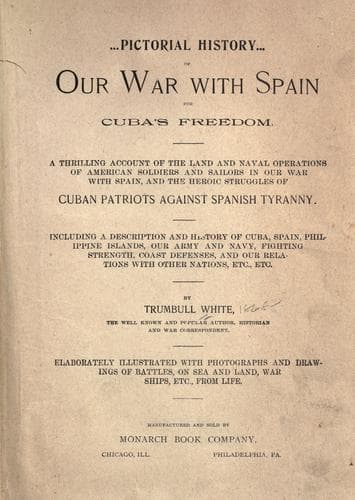
Our War with Spain for Cuba's FreedomWhite, Trumbull
History
Our War with Spain for Cuba's Freedom
White, Trumbull
Cuba -- History; Spain -- Foreign relations -- United States; Spanish-American War, 1898; United States -- Foreign relations -- Spain
Hon. C. W. Russell, an attache of the Department of Justice of the
United States, went to Cuba shortly after the order for
reconcentration went into effect. It was his purpose to learn by
personal observation how much or how little truth there was in the
reports that had come to this country regarding the terrible
suffering among the reconcentrados. He states the result of his
investigations as follows:
"I spent just two weeks in Cuba, visited Havana, went south to
Jaruco, southwest to Guines, northeast to Matanzas, eastwardly
about two hundred miles through the middle of the country to San
Domingo, Santa Clara and Sagua la Grande. I visited Marianao, a
short distance west of Havana, and saw along the railroad thirty
or forty towns or stations. In Havana I visited the Fossos, the
hospital prison at Aldecoa, where I talked with the father of
Evangelina Cisneros, and a place called the Jacoba. I found
reconcentrados at all three places, and begging everywhere about
the streets of Havana.
"The spectacle at the Fossos and Jacoba houses, of women and
children emaciated to skeletons and suffering from diseases
produced by starvation, was sickening. In Sagua I saw some sick
and emaciated little girls in a children's hospital, started three
days before by charitable Cubans, and saw a crowd of miserable
looking reconcentrados with tin buckets and other receptacles
getting small allowances of food doled out to them in a yard. In
the same city, in an old sugar warehouse, I saw stationed around
the inside walls the remnants of twenty or thirty Cuban families.
"In one case the remnant consisted of two children, seven or eight
years old. In another case, where I talked to the people in broken
Spanish, there were four individuals, a mother, a girl of
fourteen, and two quite small girls. The smallest was then
suffering from malarial fever. The next had the signs on her
hands, with which I had become familiar, of having had that
dreadful disease, the beri-beri. These four were all that order of
concentration had left alive of eleven. At San Domingo, where two
railroads join, the depot was crowded with women and children, one
of the latter, as I remember, being swollen up with the beri-beri,
begging in the most earnest way of the few passengers.
Public-domain text, read in full here on John Shaqi.
Reviews
Reviews
No reviews yet
Be the first to share your thoughts on this work.
Elsewhere in the archive
Join the Discussion
Join the discussion
Sign in to leave a comment or review.
Sign InorCreate an account