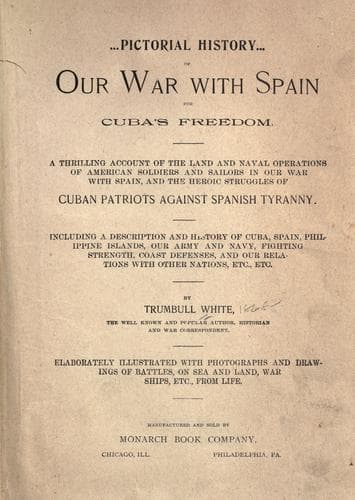
Our War with Spain for Cuba's FreedomWhite, Trumbull
History
Our War with Spain for Cuba's Freedom
White, Trumbull
Cuba -- History; Spain -- Foreign relations -- United States; Spanish-American War, 1898; United States -- Foreign relations -- Spain
"San Domingo is little more than a railroad station in times of
peace, but at present it has a considerable population, living in
cabins thatched with the tops of royal palm trees, composed of the
survivors of the reconcentrados. The huts are arranged close
together in a little clump, and the concentration order required
and apparently still requires these people to live within a circle
of small block houses, commonly dignified in the dispatches by the
name of forts. They had no work to do, no soil to till, no seed to
plant, and only begging to live on. I do not know the exact
measure of the dead-line circle drawn around them, but there was
certainly nothing within it upon which a human being could
subsist. Practically they were prisoners. At every one of the
numerous stopping places along the road a similar collection of
huts could be seen, and at most of them beggars, often nice
looking women and beautiful children, invaded the cars. Between
the stations, although I traveled always by daylight, as the
trains do not run at night, and I was observing as carefully as
possible, I saw no signs of the reconcentrados going away from the
forts. If they had gone, it takes seed, instruments, land, and
three or four months to raise the vegetable which could be soonest
produced, and nowhere away from the block houses was there any
sign of vegetables growing. Near the larger towns the circle of
concentration seemed to be somewhat larger, and some planting of
vegetables, tobacco, etc., seemed to be going on. At this a very
few persons, possibly some of the reconcentrados, found
employment.
DESERTED FIELDS AND FARMS.
"All along the railroad, as far as could be seen, were stretches
of the most fertile and beautiful country, with very few trees,
even on the low mountains, and most of these royal palms. I saw
many dozens of burned canefields, and one evening, going from
Guines to Havana, saw the sky all lighted up along the road with
fires, principally of the tall grass of the country, but partly of
cane. The whole land was lying perfectly idle, except that I saw
two or three or four sugar mills where cane was growing, but in
all such instances the mill and cane were surrounded by forts,
manned by soldiers, who are paid, I was told, by the owners.
Except in the cities, I saw no indication that any relief whatever
was being afforded to the starving people. Neither in Havana nor
elsewhere did any priest, religious woman or other person seem to
be paying any attention to the wants of the starving, except that
at the Fossos, and some other places, charitable Cubans were
nursing the sick. The Church, being a state institution, was, so
far as I could see, leaving the victims without either bodily or
spiritual relief. In fact, the general air of indifference to
suffering which seemed to prevail everywhere was astonishing.
A FEARFUL MORTALITY.
Public-domain text, read in full here on John Shaqi.
Reviews
Reviews
No reviews yet
Be the first to share your thoughts on this work.
Elsewhere in the archive
Join the Discussion
Join the discussion
Sign in to leave a comment or review.
Sign InorCreate an account