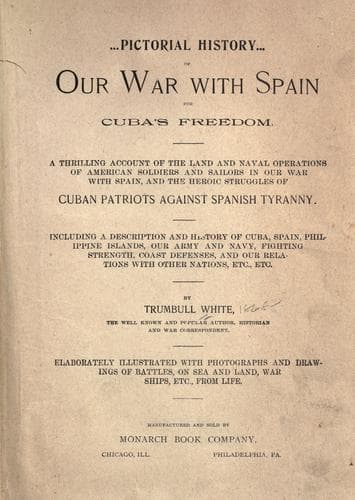
Our War with Spain for Cuba's FreedomWhite, Trumbull
History
Our War with Spain for Cuba's Freedom
White, Trumbull
Cuba -- History; Spain -- Foreign relations -- United States; Spanish-American War, 1898; United States -- Foreign relations -- Spain
I presented my credentials to the commandante. He was the most
genial Spanish official I had met between Havana and Guadaloupe.
When he smiled, his face was all kindness. When he spoke of the
reconcentrados, tears welled from his eyes. Yet around his mouth
and chin were the cruel lines of a nature as stern as it was
commiserative. He told me that the hospital was full, always full;
there was room in its wards for only 200 patients, and only one
doctor for all. All who entered that place of sickness came out of
it, not cured, but dead. Three thousand human beings, mostly women
and children, had passed away in that town in three months. Nearly
all had died of starvation and exposure. When the cemetery was
full, they began burying in the still burning tobacco fields on
the hillsides.
But it was the siesta hour. The commandante excused himself,
saying he would rest awhile and advised me to do the same.
The commandante's house was in the center of the town. Round about
was a circle of the houses of those who had owned the tobacco
fields. Beyond these homes of the well-to-do were hundreds of
huts. In these lived the reconcentrados, several families in each,
or as many as could huddle within and not pull the roughly
constructed frame of palm stalks down about their heads. Outside
the circle of huts were the blackened fields and hills. On the
tops of the hills, at intervals of 200 yards, was a circle of
small houses that looked like sentry boxes. They were really
little forts, with four soldiers in each. Beyond the forts were,
heaven only knows how many, insurgent guerillas, lynx-eyed human
watch dogs, always lurking and waiting for a chance to swoop upon
one of the little forts, slay the garrison of four and dash back
into the bushes.
A SOLDIER'S GHASTLY BURDEN.
At this moment not a soldier was in sight. Perhaps all were
sleeping, like the commandante. Or perhaps the soldiers always
remained inside the barricades surrounding their forts, fearing
that to step outside would be to attract the bullets of the
lurking insurgents. For such is warfare in Cuba's hills to-day;
much the same sort of warfare our American forefathers knew when
each man who stepped from his doorway was likely to become a
target for the arrows of the lurking and invisible redskins.
Public-domain text, read in full here on John Shaqi.
Reviews
Reviews
No reviews yet
Be the first to share your thoughts on this work.
Elsewhere in the archive
Join the Discussion
Join the discussion
Sign in to leave a comment or review.
Sign InorCreate an account