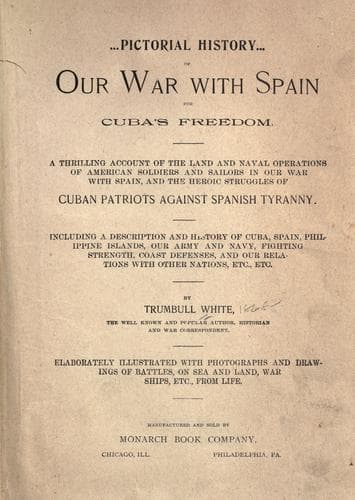
Our War with Spain for Cuba's FreedomWhite, Trumbull
History
Our War with Spain for Cuba's Freedom
White, Trumbull
Cuba -- History; Spain -- Foreign relations -- United States; Spanish-American War, 1898; United States -- Foreign relations -- Spain
I was making a mental note of this picture of war and misery, when
suddenly I saw a human form on the hilltop over which I had just
come. The peculiar shape of the white hat worn by this apparition
told me it was a soldier. In the middle of the white road he
stopped, lowered a burden from his shoulders to the ground. What
was that soldier doing there and what was the nature of his
apparently heavy burden? From my perch on the balcony I beckoned
to the sentry, who was pacing up and down in front of the
commandante's house. The sentry came up to the balcony, took one
look in the direction of my pointing finger, and then rushed into
the house. The next moment the commandante appeared. With a field
glass he surveyed the figure on the hilltop.
"He is carrying something," I said, as I watched the man in the
distance reshoulder his burden and begin descending the hill.
"A dead man," said the commandante. And he closed the glasses,
thoughtfully. Then he gave me a long black cigar.
We waited. At the end of half an hour the soldier approached the
house. Yes, on his back he was carrying a corpse.
TELL-TALE SCRAP OF PAPER.
He laid his burden down in the road and saluted the commandante. A
group of officers and soldiers had gathered round. The body was
that of a noted insurgent captain. A scrap of paper was produced.
It had been found in the dead man's pocket by the soldier who had
carried the body into town.
The commandante read the paper. His brow contracted. Now he was
all sternness.
"Bring the man, Jose Manual, here," he said to a sergeant.
Five minutes later an old man, all bones and skin, stood before
us. The miserable man trembled as with the palsy.
"Si, senor, I did it. I ran over the hill. I informed. I alone am
to blame."
Evidently the wretch knew of what he was accused. It was also
apparent that he was not the only guilty one.
"Who wrote this for you?" the commandante asked.
"I did, senor; I wrote it."
"The man lies," murmured one of the officers.
"Bring hither the son of Jose Manual," was the next order.
With that, another skeleton, a young one, stepped forward.
"I am here, senor, and I wrote the note. That is all. We two,
senor. I wrote and my father ran. He was stronger, that day, than
even my younger bones."
The commandante compressed his lips. He turned to the sergeant and
said: "At sunset have these two men shot."
The two men merely spat upon the ground. For them death evidently
had no terrors. As they were led away they made the sign of the
cross again and again upon their naked breasts. A hundred starving
wretches followed them in silence.
When we were again alone on the balcony--a broad, square balcony
it was--the commandante noticed my look of inquiry.
Public-domain text, read in full here on John Shaqi.
Reviews
Reviews
No reviews yet
Be the first to share your thoughts on this work.
Elsewhere in the archive
Join the Discussion
Join the discussion
Sign in to leave a comment or review.
Sign InorCreate an account