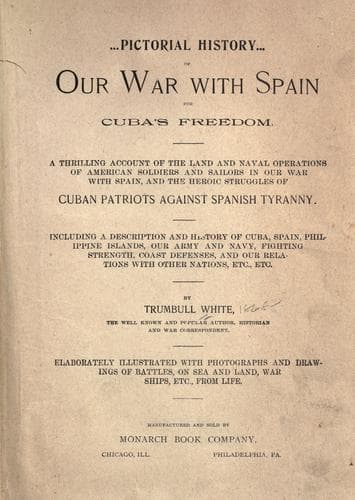
Our War with Spain for Cuba's FreedomWhite, Trumbull
History
Our War with Spain for Cuba's Freedom
White, Trumbull
Cuba -- History; Spain -- Foreign relations -- United States; Spanish-American War, 1898; United States -- Foreign relations -- Spain
Writing on December 5, Mr. Hyatt said: "The reconcentration order is
relaxed, but not removed; but many people have reached a point where it
is a matter of entire indifference to them whether it is removed or not,
for they have lost all interest in the problem of existence. A census of
the island taken to-day, as compared with one taken three years ago, I
feel confident would show that two-thirds of the residents are missing,
and the Spanish army would make no better showing."
On December 14 Mr. Hyatt wrote: "The order of reconcentration
practically has been wiped out, and, so far as the Spanish
government is concerned, men go about nearly as they please. The
insurgents and their sympathizers will unquestionably take
advantage of the revocation to get from the towns and cities what
they need and otherwise strengthen their cause. The effects on
agricultural pursuits will be disappointing, because the great
majority of those who would or should take up the work joined the
insurgent forces when compelled to leave their homes, and the
portion which came within the lines of reconcentration are women,
children, old and sickly people, most of whom seem to have little
interest in the problem of life. There is no one to take these
people back to the fields and utilize their remaining strength.
Their houses are destroyed, the fields are overgrown with weeds,
they have no seeds to plant, and, if they had, they could not live
sixty or eighty days until the crop matured; which, when grown,
would more than likely be taken by one or the other of the
contending parties."
DYING AT HIS DOOR.
"As I write," Mr. Hyatt closes this communication, "a man is dying
in the street in front of my door, the third in a comparatively
small time."
Mr. Hyatt's letter of December 21 deals largely with the sickness
and the death rate on the island, which he characterizes as
appalling. "Statistics," he says, "make a grievous showing, but
come far short of the truth. The disease is generally brought on
by insufficient food. It is sometimes called paludal fever, and at
others la grippe, and it is epidemic rather than contagious. From
30 to 40 per cent of the people were afflicted with it."
He also reported smallpox and yellow fever as prevailing, and said
that out of a total of sixteen thousand soldiers recently sent to
Manzanillo, nearly five thousand were in hospitals or quartered on
the people. He says that Dr. Gaminero, United States sanitary
inspector, reported at that time that there were more than twelve
thousand people sick in bed, not counting those in military
hospitals. This is at least 35 per cent of the present population.
Mr. Hyatt adds that quinine, the only remedy of avail, is sold ten
times higher than in the United States. He says that steamers
coming into port give out soup once a day to the waiting throngs,
and that fresh meat sells at from 50 cents to $1 a pound.
CONDEMNED TO A LIVING DEATH.
Public-domain text, read in full here on John Shaqi.
Reviews
Reviews
No reviews yet
Be the first to share your thoughts on this work.
Elsewhere in the archive
Join the Discussion
Join the discussion
Sign in to leave a comment or review.
Sign InorCreate an account