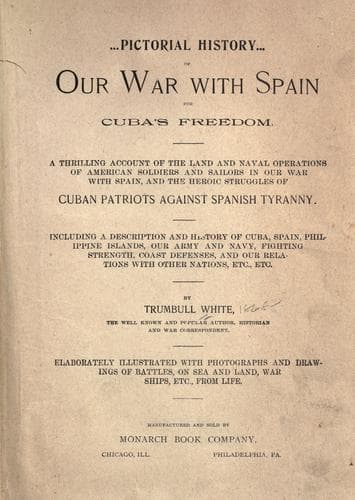
Our War with Spain for Cuba's FreedomWhite, Trumbull
History
Our War with Spain for Cuba's Freedom
White, Trumbull
Cuba -- History; Spain -- Foreign relations -- United States; Spanish-American War, 1898; United States -- Foreign relations -- Spain
Every ten days or so crowds of handcuffed men are driven through
the streets of Havana, which they will never tread again, on their
way to the transport ship which will convey them to the penal
settlements on the African coast. Many of these men represent the
elite of Cuban society. Seldom is a direct charge brought against
them. Police spies denounce them as Cuban sympathizers. They are
given no trial, that they may prove the charges false. On
administrative order they are sentenced to exile for life, and
frequently the source of their misfortune can be traced to private
revenge or personal feeling. Since the beginning of the war at
least ten thousand prominent citizens have been torn from their
native island, families and friends, and sent to life exile in the
filthy, overcrowded, deadly swamps of Fernando Po. With a little
money and good health it is possible to survive in Ceuta, but none
ever returns from Fernando Po. On the 23d of March a large party
of citizens of the Matanzas district passed through Havana on
their way to the transport. It was a sad procession. Hopeless,
jaded, despairing men, with arms tied behind them and feet
shackled, forced to leave Cuba and face a slow, horrible death. On
the train from Matanzas two of these unfortunates were literally
shot to pieces. The guards reported they tried to escape and were
shot in the attempt. Their fellow-prisoners told a different
story. "The two men were deliberately taken out on the platform
between the cars and fired upon. And the soldiers would give no
reason." The action could likely be traced to personal revenge.
For three-quarters of a century the misgovernment of Spain in Cuba
was a neighborhood shame and scandal to the people of the United
States. Warning off the interference of any other foreign nation,
under the policy known as the "Monroe Doctrine," the American
people witnessed the repeated efforts of a less favored nation of
this hemisphere to release itself from the grasp of the oppressor.
They witnessed at the periods of each of these revolts their own
ships of war patroling the southern coast and the waters adjacent
to Cuba to intercept any young Americans whose sympathies might
lead them to join the Cuban cause, and they acquiesced, because
the law as it stood exacted it. They witnessed in more than one of
these revolts, when some young Americans, who had eluded the
vigilance of United States cruisers, landed on the island and were
captured by Spanish troops. These young men stood against the
walls of Morro Castle and were shot like dogs, because their
government was powerless under the law to aid them. They witnessed
the offers on the part of their government at various times to
terminate the continued scandal upon civilized government at one
of the doorways of their country by the purchase of the island for
a generous sum of money, and the rejections of such propositions
by Spain.
Public-domain text, read in full here on John Shaqi.
Reviews
Reviews
No reviews yet
Be the first to share your thoughts on this work.
Elsewhere in the archive
Join the Discussion
Join the discussion
Sign in to leave a comment or review.
Sign InorCreate an account