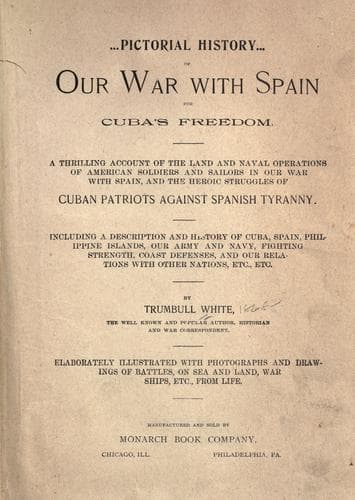
Our War with Spain for Cuba's FreedomWhite, Trumbull
History
Our War with Spain for Cuba's Freedom
White, Trumbull
Cuba -- History; Spain -- Foreign relations -- United States; Spanish-American War, 1898; United States -- Foreign relations -- Spain
Finally, owing to the unsettled conditions resulting from the war,
he sent his family back to the United States, and joined the
insurgent army. His brother-in-law also espoused the Cuban cause,
and was killed in battle. Discouraged by his reverses, he decided
to return to his native land, and made his escape from the island
by boarding a blockade runner, which landed him at Atlantic City,
from where he walked to New York. Grand Army comrades gave him
food and shelter, and assisted him to reach his family. This man
has a personal interest in the success of the cause, for when that
time comes he hopes to regain possession of his property.
THE CASE OF PEDRO CASANOVA.
Pedro Casanova, a citizen of the United States, resided near the
little railway station of San Miguel de Jaruca with his family,
which consists of his wife and three children and his nephew, the
latter born in the United States. He told the story of his wrongs
at the hands of the Spaniards to a representative of the New York
Herald in the following words:
"I have suffered great outrages from the Spanish soldiers. The
soldiers recently passed on the road, and my wife called my
attention to the fact that they had broken into a vacant house
where valuable property was stored, and were pulling things in
pieces. Just then I saw two officers coming toward the house. I
was very glad, and went out to meet them, and invited them to
enter the house and refresh themselves. They accepted, and said
they liked coffee. While they were drinking, one or two soldiers
came and spoke to the captain, who asked me, 'Who are the men in
the sugar house?' 'My employes,' I replied, 'including one
engineer. The others are engaged in repairs.'
"The captain said: 'I hear rebels are hidden there. I must take
the men before the major for examination; the major himself will
be here to-morrow.'
"After he left I found the door of the house on the hill broken
open. A quantity of bottled beer had been taken, also my saddles
and bridles, and many other things. Gloves and other articles of
woman's apparel were tossed in the yard. I went to the station.
The drug store looked as if it had been visited by a mad bull. All
the shelves and drawers were thrown out and smashed. An empty
store opposite was in the same condition. The counter was thrown
down and the door posts hacked by machetes. The large coffee mill
was broken, and all was in disorder. An account of this work was
what the soldiers had whispered to the captain. The officer had
remarked to me with a sneer: 'The insurgents are very kind to you,
as no harm has been done here.'
Public-domain text, read in full here on John Shaqi.
Reviews
Reviews
No reviews yet
Be the first to share your thoughts on this work.
Elsewhere in the archive
Join the Discussion
Join the discussion
Sign in to leave a comment or review.
Sign InorCreate an account