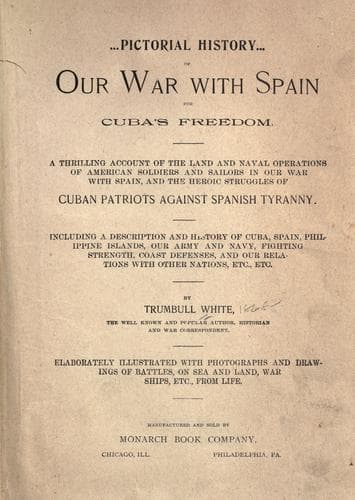
Our War with Spain for Cuba's FreedomWhite, Trumbull
History
Our War with Spain for Cuba's Freedom
White, Trumbull
Cuba -- History; Spain -- Foreign relations -- United States; Spanish-American War, 1898; United States -- Foreign relations -- Spain
The American people finally realized that peace could never come
to Cuba until it was imposed by the action of the United States,
and the opinion gradually grew that neither international
obligations nor a desire for the maintenance of friendly relations
with Spain could justify our government in permitting these
outrages to continue at our doors.
CHAPTER XXX.
OUTRAGES ON AMERICANS IN CUBA.
How Spain Pays Her Debts--An Old Soldier's Experience--The Case
of Pedro Casanova--Destruction of Property--Robbery and Murder--A
Cruel Attack--The Insurgents to the Rescue--Hiding in a Cane
Field--The Appeal to the Consul--Intervention Justifiable.
Many American citizens in Cuba have been confined in Spanish
prisons, a number have been sent to the penal colonies, the
property of some has been confiscated, and others have been
murdered in cold blood. A celebrated case, which shows how slowly
the wheels of justice sometimes revolve, was that of Antonio
Maximo, a naturalized American citizen. He was condemned to death,
and his estates declared the property of the government, by order
of a court-martial, in 1870. He was charged with participating in
the revolution then going on in Cuba and convicted, in spite of
the fact that he was not residing on the island. The United States
demanded restitution and indemnification, and in 1873 the Spanish
republic admitted that the claim was just. The decree was
confirmed in 1876 by the royal government, but the authorities in
Cuba delayed its execution until the estates were in ruins. Spain
finally offered the sum of 1,500,000 pesos as indemnity, and this
offer was accepted in 1886. The Cortes, however, made no
appropriation for the payment, and in 1888 the Spanish minister of
state attempted to affix to the agreement the new condition that
certain claims of Spanish subjects should be adjudicated and
settled simultaneously. Secretary Bayard rejected the proposition,
and our government continued to urge the Spanish authorities to
fulfill their contract. On June 12, 1895, Secretary Olney
instructed Hannis Taylor, United States minister at Madrid, to ask
Spain to give assurances that she would settle the claim within
two months. The Spanish government then offered to pay the
principal of the claim, and the claimant agreed to forego the
interest. On September 14, the original claimant having died, the
Spanish government paid $1,499,000, equal to 1,500,000 pesos, in
settlement of the long-standing claim.
AN OLD SOLDIER'S EXPERIENCE.
William Ewing, of Buffalo, New York, served in the Seventeenth
United States infantry all through the civil war, and is a member
of the G. A. R. He went to Cuba, and invested $7,000, all the
money he had, in a sugar plantation, and with his wife and
daughter and his brother-in-law, William Hamilton, he took up his
abode on the island.
Public-domain text, read in full here on John Shaqi.
Reviews
Reviews
No reviews yet
Be the first to share your thoughts on this work.
Elsewhere in the archive
Join the Discussion
Join the discussion
Sign in to leave a comment or review.
Sign InorCreate an account