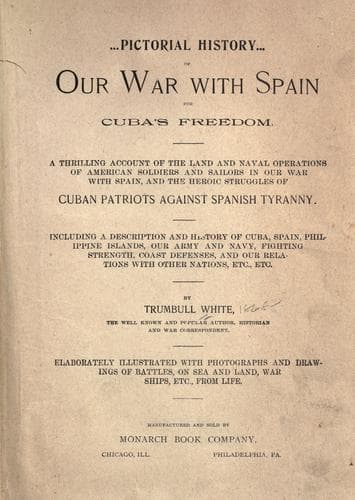
Our War with Spain for Cuba's FreedomWhite, Trumbull
History
Our War with Spain for Cuba's Freedom
White, Trumbull
Cuba -- History; Spain -- Foreign relations -- United States; Spanish-American War, 1898; United States -- Foreign relations -- Spain
Miss Cisneros was given a great reception in Madison Square
garden, during her stay in New York, where many noted men and
women congratulated her on her happy escape, and welcomed her to
"the land of the free, and the home of the brave." Since then she
has become the protege of Mrs. John A. Logan, widow of the famous
General, and is now a member of her family.
It is suspected that General Weyler connived at the escape of Miss
Cisneros, as it is not probable that it could have been
accomplished without the knowledge of the prison officials, and as
they were not called to account for their negligence, it would
seem that they were simply obeying orders in keeping their eyes
conveniently closed.
The Military Judge of Havana issued a proclamation commanding Miss
Cisneros to return to prison, but it was evident that this was
merely a legal formality. There were men in Cuba, occupying high
official positions, who could not afford to have the story of the
persecutions of which she was a victim, while in voluntary exile
with her father in the Isle of Pines, made known, for it would
have gained for them the scorn and contempt of the civilized
world. Her case had attracted the attention of men and women of
prominence, not only in our own country, but in England, France
and Germany as well, and it was likely to become an international
affair, and Weyler probably decided to escape these complications
by allowing her to be "rescued" from her prison cell.
While all the details of the affair go to prove that this
supposition is correct, all concerned have guarded the secret
well, and it is but just to state that there is no direct proof to
support the theory, and both the man who planned and the one who
executed deserved all the honors they received.
CHAPTER XXXIII.
WORK OF MISS CLARA BARTON AND THE RED CROSS.
The Geneva Conference--Miss Barton's Work in the War of the
Rebellion--Organization of the American Red Cross--The Work in
Cuba--Appeal to the Public--A Floating Hospital--Correspondence
with Admiral Sampson--The Spanish Prisoners in Key West, and What
the Red Cross Did for Them.
Many attempts have been made to bring about an international
agreement for mitigating the horrors and mortality of battle. The
first successful movement of this kind was started at the same
time that the civil war was raging in the United States. A
conference of jurists and others interested in humanitarian work
was held in Geneva, Switzerland, in 1863. They drew up an
international compact, which was approved by the Swiss government,
and the support and sanction of the French empire were won. It was
several years, however, before the articles of agreement were
signed by all the civilized nations of the world, and, strange to
relate, the United States was the last of the great powers to
officially recognize the rights to special protection secured to
the bearers of the Red Cross symbol.
Public-domain text, read in full here on John Shaqi.
Reviews
Reviews
No reviews yet
Be the first to share your thoughts on this work.
Elsewhere in the archive
Join the Discussion
Join the discussion
Sign in to leave a comment or review.
Sign InorCreate an account