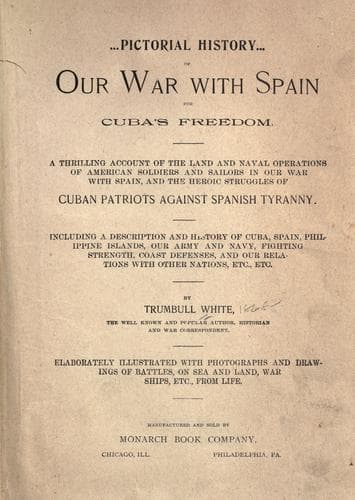
Our War with Spain for Cuba's FreedomWhite, Trumbull
History
Our War with Spain for Cuba's Freedom
White, Trumbull
Cuba -- History; Spain -- Foreign relations -- United States; Spanish-American War, 1898; United States -- Foreign relations -- Spain
In the autumn of 1881 a final effort was made to gain the
agreement of the United States to the stipulations of the
convention of Geneva, and assurances were given by President
Arthur of his willingness to accede. The President and the Senate
subsequently formally recognized the association, and the treaty
was signed March 16, 1882. Pending this action by the government,
a national society was formed and incorporated under the laws of
the District of Columbia, bearing the name of the American
Association of the Red Cross.
By this international treaty the Red Cross society is given
peculiar privileges in times of war, and its agents and officers
are permitted to carry on their work without hindrance from either
of the belligerents, but they are prohibited from having anything,
however remote, to do with military or naval operations. They deal
exclusively with the means provided to aid the wounded, relieve
the suffering, and care for the sick, in all of which the Red
Cross agents know neither friend nor foe. In case of a battle the
ambulances, surgeons and nurses of the society go upon the field
at soon as it is possible for them to do so and carry out the work
of mercy that has been undertaken.
The American society has been generous in extending its aid to
other countries in times of war, and during the Franco-Prussian
hostilities in 1870-71 it sent to Paris from its own funds
$120,000, while the French branch expended $2,500,000. Even the
Spanish branch contributed to the humanitarian work of that war in
the sum of $4,000. In the Turko-Russian, the Tunisian, the
Tonquin, the Madagascar, the Greeco-Turkish and several other wars
the Red Cross has carried on its work of mercy.
MISS CLARA BARTON.
When the war of the Rebellion begun Miss Clara Barton was a clerk
in the Patent Office in Washington. She resigned her position to
devote herself to the care of wounded soldiers on the field of
battle. In 1864 she was appointed by General Butler "lady in
charge" of the hospitals at the front of the Army of the James. In
1865 she was sent to Andersonville, Georgia, to identify and mark
the graves of Union soldiers buried there, and in the same year
was placed by President Lincoln in charge of the search for the
missing men of the Union army, and while engaged in this work she
traced out the fate of 30,000 men. In 1873 she inaugurated a
movement to secure recognition of the Red Cross society by the
United States government, and finally, during the administration
of President Arthur, she saw her labors rewarded. She naturally
became President of the American branch of the society, which was
founded in 1882, and she still holds that honored office.
WORK IN CUBA.
Public-domain text, read in full here on John Shaqi.
Reviews
Reviews
No reviews yet
Be the first to share your thoughts on this work.
Elsewhere in the archive
Join the Discussion
Join the discussion
Sign in to leave a comment or review.
Sign InorCreate an account