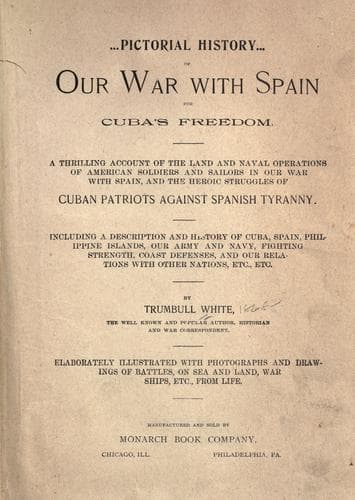
Our War with Spain for Cuba's FreedomWhite, Trumbull
History
Our War with Spain for Cuba's Freedom
White, Trumbull
Cuba -- History; Spain -- Foreign relations -- United States; Spanish-American War, 1898; United States -- Foreign relations -- Spain
1. That the United States battleship Maine arrived in the harbor
of Havana, Cuba, on the twenty-fifth day of January, Eighteen
Hundred and Ninety-eight, and was taken to Buoy No. 4, in from
five and a half to six fathoms of water, by the regular Government
pilot. The United States Consul-General at Havana had notified the
authorities at that place the previous evening of the intended
arrival of the Maine.
2. The state of discipline on board the Maine was excellent, and
all orders and regulations in regard to the care and safety of the
ship were strictly carried out. All ammunition was stowed in
accordance with prescribed instructions, and proper care was taken
whenever ammunition was handled. Nothing was stowed in any one of
the magazines or shell rooms which was not permitted to be stowed
there.
The magazine and shell rooms were always locked after having been
opened, and after the destruction of the Maine the keys were found in
their proper place in the Captain's cabin, everything having been
reported secure that evening at eight P. M. The temperatures of the
magazines and shell room were taken daily and reported. The only
magazine which had an undue amount of heat was the after 10-inch
magazine, and that did not explode at the time the Maine was destroyed.
The torpedo warheads were all stowed in the after part of the ship
under the ward room, and neither caused nor participated in the
destruction of the Maine. The dry gun cotton primers and
detonators were stowed in the cabin aft, and remote from the scene
of the explosion.
Waste was carefully looked after on board the Maine to obviate
danger. Special orders in regard to this had been given by the
commanding officer. Varnishes, dryers, alcohol and other
combustibles of this nature were stowed on or above the main deck
and could not have had anything to do with the destruction of the
Maine. The medical stores were stored aft under the ward room and
remote from the scene of the explosion. No dangerous stores of any
kind were stowed below in any of the other store rooms.
The coal blinkers were inspected daily. Of those bunkers adjacent
to the forward magazines and shell rooms four were empty, namely,
"B3, B4, B5 and B6." "A5" had been in use that day and "A16" was
full of new river coal. This coal had been carefully inspected
before receiving it on board. The bunker in which it was stowed
was accessible on three sides at all times, and the fourth side at
this time, on account of bunkers "B4" and "B6" being empty. This
bunker, "A16" had been inspected Monday by the engineer officer on
duty.
Public-domain text, read in full here on John Shaqi.
Reviews
Reviews
No reviews yet
Be the first to share your thoughts on this work.
Elsewhere in the archive
Join the Discussion
Join the discussion
Sign in to leave a comment or review.
Sign InorCreate an account